Pan-India economic intelligenceDaily Edition — 2026-07-11
AI2

Ai2India

Daily Edition

One daily issue tracking AI adoption, markets, hiring, layoffs, real estate, credit and gig-work signals across India.

PublishedJuly 11Daily issue
Nifty 50 (Jul 10 close)24,207+325 pts (+1.36%) recovery rally; IT +2% leads on TCS AI revenue beat; Realty +2.8%; Smallcap +1.6%
USD / INR95.43Jul 10 close, +2 paise; Rupee holds near 95.40 on RBI intervention and FPI inflows post-TCS; range 94.90–95.80 near term
Brent Crude$78.00/bblJul 10 +0.6% on Hormuz risk; Trump Iran stance keeps floor; WTI $76.23; supply disruption premium intact
Repo Rate (RBI)5.50%Jun 5 MPC hold; Aug MPC next window; Warsh Fed hike bias binds RBI; Oct first realistic cut window; CPI benign but external constraint binding

Lead Analysis — Global AI Frontier

Three convergent AI frontiers reshape enterprise procurement this week: xAI’s Grok 4.5 co-trained with Cursor for agentic coding, OpenAI’s GPT-Live full-duplex voice with GPT-5.5 delegation, and Chinese models capturing 30–46% of US developer tokens — a cost-driven structural shift validating India’s DeepSeek self-hosted strategy while triggering US regulatory scrutiny

Friday, July 11, 2026: Three simultaneous frontier AI launches define the week. First, xAI (SpaceXAI) released Grok 4.5, its smartest model to date, explicitly co-trained with the Cursor code editor for coding, agentic tasks, and knowledge work — benchmarking at 62% DeepSWE 1.0, 83.3% Terminal-Bench, 64.7% SWE-Bench Pro at $2/M input, $6/M output with 80 tokens/second throughput. Second, OpenAI launched GPT-Live, a full-duplex voice architecture that listens and speaks simultaneously, provides backchannels while the user talks, and delegates complex tasks to GPT-5.5 running in the background — replacing Advanced Voice Mode for 150+ million weekly ChatGPT voice users. Third, CNBC/OpenRouter data confirms Chinese AI models (DeepSeek V4, Z.ai GLM-5.2) now account for 30–46% of US developer token usage weekly since February 8, up from 4.5% in H1 2025 — a structural cost-driven shift that validates India’s DeepSeek self-hosted enterprise strategy while triggering US regulatory scrutiny.

xAI’s Grok 4.5 release is notable for its explicit co-training partnership with Cursor — the first frontier model launch to publicly align model training with a specific developer toolchain. The model runs at 80 tokens/second and uses 4.2x fewer output tokens than Claude Opus 4.8 on SWE-Bench Pro (15,954 vs 67,020 tokens), indicating meaningful efficiency gains for agentic coding workflows. Pricing at $2/M input and $6/M output positions it between Sonnet 5 ($2/M promotional) and GPT-5.6 Sol ($5/M). Grok 4.5 is immediately available in Grok Build (default model), Cursor (all plans), and the SpaceXAI console — but not yet in the EU (mid-July rollout expected). For Indian enterprises, the Cursor integration is the actionable signal: developer teams already on Cursor get frontier agentic coding capability without new procurement or toolchain changes.

OpenAI’s GPT-Live represents a fundamental architectural shift: full-duplex voice that listens and speaks simultaneously, provides backchannels (“mhmm,” “okay”) while the user talks, and decides several times per second whether to speak, listen, pause, interrupt, or invoke a tool. The second architectural shift is delegation: GPT-Live offloads complex tasks (web search, deep reasoning, agentic work) to GPT-5.5 running in the background while maintaining verbal conversation flow. Two versions roll out today: GPT-Live-1 for paid tiers and GPT-Live-1 mini for free users; API access waitlist open. Audio-native safety evaluations (self-harm, psychosis, emotional dependence, violence, sexual content) and strengthened teen protections are new. For India’s voice-first user base and vernacular AI initiatives (Sarvam, Bhashini), GPT-Live sets a new UX benchmark that domestic voice AI products will need to match.

The Chinese AI market share surge is the most consequential signal for Indian enterprise AI planners. CNBC’s analysis, drawing on OpenRouter token-level data and Brookings Institution commentary, shows Chinese models have exceeded 30% of US developer tokens every week since February 8, 2026, peaking at 46%. The prior 12-month average was 11%; H1 2025 was 4.5%. DeepSeek V4-Flash at ~$0.14/M input tokens is 35x cheaper than GPT-5.6 Sol ($5/M) and 14x cheaper than Sonnet 5 promotional ($2/M). AI startup Lindy switched 100% from Anthropic to DeepSeek, projecting millions in annual savings. Z.ai’s GLM-5.2 saw 27-fold token volume growth on Vercel in its first week. The US government is reportedly considering restrictions on Chinese AI model access — a policy risk for API-based DeepSeek usage but not for MIT-licensed self-hosted deployments. For Indian regulated sectors (BFSI, healthcare, government), the self-hosted DeepSeek V4 architecture remains the only path that simultaneously addresses cost, data localisation, and supply-chain sovereignty.

Today’s TCS Q1 FY27 results (announced post-market July 10) provide the first hard AI revenue data of the earnings season: AI revenue crossed $2.6 billion annualised run-rate, the order book stands at $9.5 billion, revenue grew 14% to ₹72,275 crore, net profit rose 4.6% to ₹13,349 crore, and an interim dividend of ₹12 was declared. The Nifty IT index gained 2% on the day. The key watch items for the earnings call are: explicit AI services revenue percentage (benchmarked against NASSCOM’s $10–12B projection), headcount direction after FY26’s net –23,460, and Q2 FY27 guidance. Infosys reports July 16–17, with consensus expecting a guidance cut to 1–2.5% CC revenue growth.

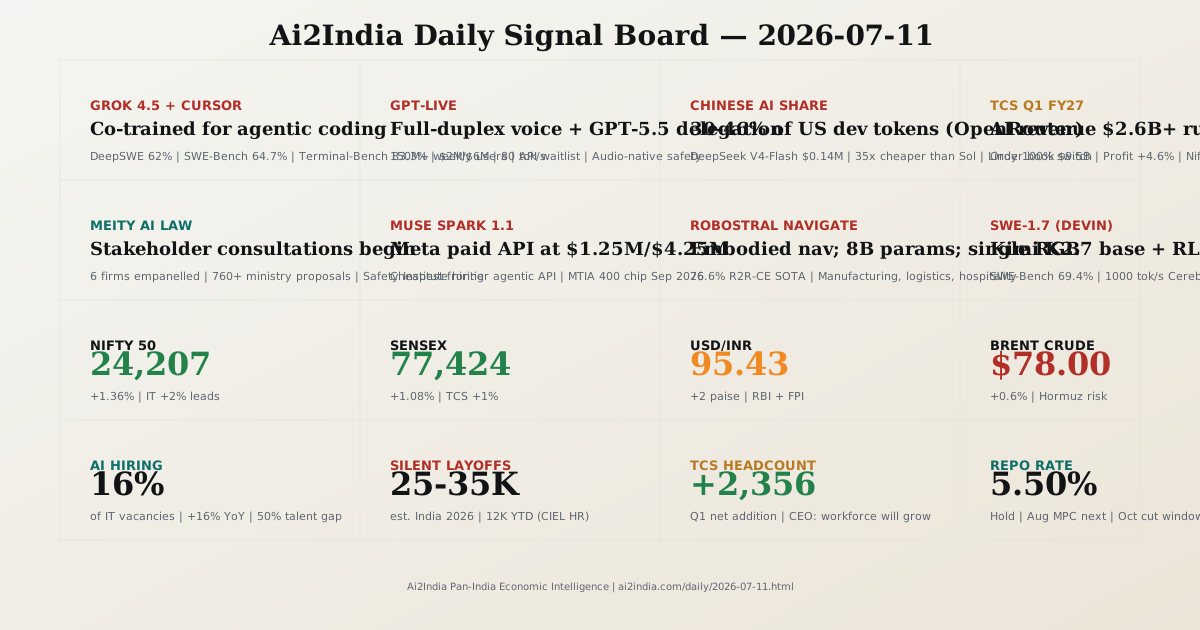
July 11, 2026 signal board: Grok 4.5 co-trained with Cursor; GPT-Live full-duplex voice; Chinese AI 46% US dev tokens; TCS AI revenue $2.6B; MeitY AI law consultations; Nifty 24,207; INR 95.43; Brent $78
Today’s economic signal board. Full analysis in the Daily Edition.

AI Developments Today

Friday, July 11, 2026: five verified AI developments that change what Indian enterprise AI planners must track this week. Grok 4.5 with Cursor co-training raises the agentic coding bar; GPT-Live sets a new voice UX paradigm with background delegation; Chinese AI market share surge validates the open-weight cost shift at US production scale; Meta Muse Spark 1.1 enters the paid model tier; Mistral Robostral Navigate opens physical AI navigation.

DevelopmentSource + DateIndia RelevanceWhat this means for Indian enterpriseStatus
xAI launches Grok 4.5 co-trained with Cursor — 62% DeepSWE, 64.7% SWE-Bench Pro, 83.3% Terminal-Bench; $2/M in, $6/M out; 80 tok/s; 4.2x token efficiency vs Opus 4.8; available in Grok Build, Cursor, SpaceXAI console

SpaceXAI (xAI) launched Grok 4.5 on July 8, 2026, described as its smartest model to date, designed to excel at coding, agentic tasks, and knowledge work. The model was trained jointly with Cursor, a partnership explicitly highlighted by SpaceXAI. On published benchmarks, Grok 4.5 places in the leading pack: DeepSWE 1.0 pass@1 62.0%; Terminal-Bench 2.1 83.3%; SWE-Bench Pro 64.7%. On efficiency, the model runs at 80 tokens/second and uses about 4.2x fewer output tokens than Claude Opus 4.8 (max mode) on SWE-Bench Pro (15,954 tokens average vs 67,020). Training relied on tens of thousands of NVIDIA GB300 GPUs and large-scale RL on hundreds of thousands of software engineering tasks. Pricing: $2/M input, $6/M output. Grok 4.5 becomes the default model in Grok Build (can build complex Excel, PowerPoint with native shapes, Word docs), available in Cursor (all plans), and via the SpaceXAI console — but not yet in the EU (mid-July rollout expected).
SpaceXAI blog (Jul 8, 2026); jls42.org coverage (Jul 8) Three India dimensions. First, Cursor integration: Indian developer teams already on Cursor (widely adopted in Indian IT services, GCCs, startups) get immediate frontier agentic coding capability without new procurement or toolchain changes. Second, Grok Build capabilities: native Excel/PPT/Word generation expands the use case surface for Indian enterprise document automation workflows. Third, pricing position: $2/M input sits between Sonnet 5 promotional ($2/M) and GPT-5.6 Sol ($5/M), making it a viable middle-tier option for cost-sensitive agentic workloads. No India-specific access restriction noted; EU delay suggests regulatory review pattern that may extend to other jurisdictions. For Indian IT services firms and GCCs: audit Cursor adoption across teams – Grok 4.5 is now the default model there. For agentic coding pilots: benchmark Grok 4.5 vs Sonnet 5 vs DeepSeek V4 on your internal SWE-Bench-equivalent tasks. For document automation: test Grok Build’s native Office format generation against current RPA/GenAI pipelines. Note EU exclusion – if your delivery model serves EU clients from India, confirm data residency compliance before production use. Verified global — SpaceXAI; Jul 8, 2026
OpenAI launches GPT-Live — full-duplex voice architecture replacing Advanced Voice Mode; listens and speaks simultaneously; delegates complex tasks to GPT-5.5 in background; 150M+ weekly ChatGPT voice users; GPT-Live-1 (Go/Plus/Pro) and mini (free); API waitlist open

OpenAI launched GPT-Live on July 8, 2026, a new generation of voice models that replaces Advanced Voice Mode as the engine for ChatGPT Voice. Unlike previous generations (transcription/LLM/synthesis cascade, then turn-taking model waiting for silence), GPT-Live is built on a full-duplex architecture: it listens and speaks at the same time, gives backchannels (“mhmm,” “okay”) while the user is talking, and decides several times per second whether it should speak, listen, pause, interrupt, or invoke a tool. Second architectural shift: GPT-Live delegates complex tasks (web search, deep reasoning, agentic work) to a frontier model — GPT-5.5 at launch — while keeping the conversation going verbally as that work runs in the background. Two versions roll out today to all ChatGPT users (iOS, Android, web): GPT-Live-1 for Go/Plus/Pro, GPT-Live-1 mini for free users. API access planned soon, waitlist open. On internal evaluations (GPQA, BrowseComp, a tau3-Voice Telecom variant), GPT-Live-1 clearly outperforms Advanced Voice Mode and is preferred by human raters. More than 150 million people use voice and dictation on ChatGPT every week. Safety: expanded audio-native evaluations (self-harm, psychosis, emotional dependence, violence, sexual content), active real-time safeguards, strengthened teen protections with possible parent notification on distress signs.
OpenAI blog (Jul 8, 2026); jls42.org coverage (Jul 8) Three India dimensions. First, UX benchmark: GPT-Live sets a new standard for voice AI interaction that Indian voice AI products (Sarvam voice, Bhashini, vernacular assistants) will be measured against. The full-duplex + backchannel + interruption handling combination is a significant UX leap over turn-based voice. Second, delegation architecture: the pattern of a lightweight voice model delegating to a heavyweight reasoning model in the background is replicable for Indian voice agents using sovereign models (Sarvam) for voice + cloud frontier models for reasoning. Third, API access: when GPT-Live API opens, Indian enterprises building voice-first applications (customer support, vernacular banking, government services) will have a new primitive to build on — but access timeline is uncertain (waitlist only today). For product teams building voice AI: study GPT-Live’s full-duplex UX patterns (backchannels, interruption handling, simultaneous listen/speak) as design targets for Sarvam/Bhashini voice stacks. For architecture teams: the voice-frontend + reasoning-backend delegation pattern is directly applicable to Indian multi-model stacks (lightweight voice model on-device/edge + Sarvam/cloud frontier for reasoning). For compliance teams: monitor GPT-Live API terms when available – voice data processing, audio retention, and teen protection features may have DPDPA implications for Indian deployments. Verified global — OpenAI; Jul 8, 2026
Chinese AI models surge to 30–46% of US developer token usage via OpenRouter — DeepSeek V4 and Z.ai GLM-5.2 gain ground as OpenAI/Anthropic costs rise; was 4.5% in H1 2025; Lindy switched 100% from Anthropic to DeepSeek; Z.ai GLM-5.2 saw 27x token growth on Vercel in first week; US government considering restrictions

A major analysis published by CNBC on July 7, 2026, drawing on OpenRouter token-level data and interviews with developers and analysts, reveals that Chinese-built AI models now account for 30 to 46% of all developer token usage on OpenRouter every week since February 8, 2026. The shift is quantitatively dramatic: in the first half of 2025, Chinese AI models averaged 4.5% of OpenRouter token volume. Over the prior 12 months, the average was 11%. Since February 2026, the floor has been above 30%, with peaks at 46%. The models driving this shift are DeepSeek (V4-Pro and V4-Flash) and Z.ai’s GLM-5.2, a model that saw 27-fold daily token volume growth on Vercel in its first week of availability. AI startup Lindy, which previously ran on Anthropic’s models, moved 100% of its traffic to DeepSeek — a switch it projects will save millions of dollars annually. Brookings Institution fellow Kyle Chan, interviewed by CNBC, framed the driver clearly: “Chinese AI models are particularly attractive to American companies now as AI costs skyrocket. Where previously US companies were prioritising AI adoption regardless of model, now they’re getting more cost-conscious.” The token-level pricing gap is stark: DeepSeek V4-Flash API is approximately $0.14 per million input tokens versus GPT-5.6 Sol at $5 per million (35 times more expensive) and Anthropic Sonnet 5 at $2 per million (promotional, otherwise $3). The US government’s response is the policy watchpoint: the Trump administration is reportedly considering measures to limit Chinese AI model access in the United States.
CNBC (Jul 7, 2026); OpenRouter token data; Brookings Institution (Jul 7); Resultsense (Jul 7) Two India dimensions. First, validation of the India enterprise DeepSeek strategy: the CNBC data shows that the cost-driven shift to Chinese open-weight AI is not a fringe developer preference — it is the mainstream enterprise AI procurement pattern in the US. Indian enterprises that adopted DeepSeek V4 for self-hosted regulated-sector workloads or volume API tasks are now in alignment with the production-scale deployment pattern of leading US technology companies. This external validation should accelerate BFSI, healthcare, and government enterprise teams that had been hesitant about DeepSeek adoption due to perceived novelty or supply-chain concern. The supply-chain argument is now harder to sustain: if the model is in production at scale across US enterprises and developer platforms, the operational maturity evidence base is large. Second, US regulatory risk: if the US government introduces access restrictions on Chinese AI models, India will face a decision point — whether to align with US restrictions or maintain independent access. India’s technology relationship with the US (the India-US AI partnership framework) creates pressure to align; India’s cost and sovereignty interests create pressure to maintain access. MeitY will need to take a public position on Chinese AI model access in India if US restrictions materialise. For enterprise AI architects: the 30–46% US adoption data is the strongest available validation of the DeepSeek cost-efficiency argument. Use this data in internal AI cost governance discussions — it removes the “only Indian enterprises consider DeepSeek” objection. For regulated sectors (BFSI, healthcare, government): accelerate DeepSeek V4-Flash self-hosted evaluation specifically for workloads currently on expensive US lab APIs. Begin scenario planning for potential US restriction on Chinese AI model access (low probability near-term but strategic risk to monitor). The self-hosted architecture is the hedge: MIT licence + on-premises = independent of both US lab pricing and potential Chinese API restrictions. Verified global — CNBC; OpenRouter; Brookings; Jul 7, 2026
Meta launches Muse Spark 1.1 — first paid model via new Meta Model API; agentic and coding model at $1.25/M input, $4.25/M output; cheaper than Grok 4.5 and Opus; available in Meta AI

Mark Zuckerberg announced on X on July 9, 2026 that Meta is releasing Muse Spark 1.1, described as a strong agentic and coding model at a very low price. It is available through the new Meta Model API and in Meta AI. Pricing at $1.25 per million input tokens and $4.25 per million output tokens undercuts Grok 4.5 ($2/$6) and Anthropic Opus 4.8. The model powers Meta AI’s Thinking mode. This marks Meta’s first paid model API offering, moving beyond the Llama open-weight strategy into commercial API pricing. Meta also plans to begin mass production of its self-designed AI semiconductor, the MTIA 400, in September, aiming to reduce dependence on Nvidia and AMD to secure long-term price competitiveness.
Meta blog/Zuckerberg X (Jul 9, 2026); Memeburn (Jul 9); AI2ROI (Jul 9) India relevance: Meta’s entry into paid model API at sub-Grok pricing adds a new option for cost-sensitive Indian enterprises. Muse Spark 1.1 at $1.25/$4.25 is the cheapest frontier-tier agentic coding model API currently available (beating Sonnet 5 promo $2/$6 and Grok 4.5 $2/$6). For Indian IT services firms building AI coding assistants, this expands the multi-model procurement menu. MTIA 400 production in September is a longer-term signal for AI infrastructure cost reduction globally. For AI procurement teams: add Muse Spark 1.1 to the evaluation matrix for agentic coding workloads – it’s the current price floor among proprietary frontier APIs. For infrastructure teams: MTIA 400 mass production timeline (Sep 2026) could shift Meta’s cloud AI pricing further down by Q4 2026. For compliance: Meta Model API terms and data processing addenda need DPDPA review before production use with Indian customer data. Verified global — Meta; Jul 9, 2026
Mistral launches Robostral Navigate — first embodied navigation model; 8B parameters; single RGB camera, no LiDAR/depth; 76.6% on R2R-CE (SOTA for single-camera); targets manufacturing, delivery, logistics, hospitality

Mistral AI launched Robostral Navigate on July 8, its first model dedicated to embodied navigation: an 8-billion-parameter model that moves a robot from a single RGB camera — without LiDAR or depth sensor — and a natural-language instruction. On R2R-CE (Room-to-Room in Continuous Environments), the reference benchmark for instruction-based navigation, Robostral Navigate reaches 76.6% success rate on unseen validation, exceeding the best previous single-camera approach (~66.9%) and even best depth/multi-camera approaches (~72.1%). The model predicts target position coordinates directly in the camera image rather than metric movements, making it robust to camera intrinsics changes. Built entirely in-house (without third-party open-source VLM), initialized from Mistral’s specialized VLM for pointing/counting/object localization, and trained on ~400,000 simulated trajectories across 6,000 scenes. Prefix-caching with tree attention masking reduces training tokens by 22x vs step-by-step sampling; online RL post-training (CISPO, in-house algorithm) adds 3.2 success-rate points without saturation signs. Runs on wheeled, legged, and flying robots; targets manufacturing, delivery, logistics, hospitality use cases.
Mistral AI blog (Jul 8, 2026); jls42.org coverage (Jul 8) India relevance: Physical AI / robotics is an emerging category for Indian manufacturing (PLI schemes), warehouse automation (e-commerce, quick commerce), and defence. An 8B parameter model running on a single RGB camera dramatically lowers the hardware cost floor for vision-based robot navigation – no LiDAR, no depth sensor, no multi-camera rig. For Indian robotics startups (GreyOrange, Addverb, Systemantics, etc.) and manufacturing automation teams, this model architecture is directly applicable to cost-sensitive Indian deployments. Mistral’s open-weight history suggests Robostral may follow an open licence path, which would enable on-premises deployment in Indian factories without cloud dependency. For Indian robotics/automation teams: evaluate Robostral Navigate against current LiDAR/depth-sensor navigation stacks for cost reduction potential. For manufacturing PLI applicants: single-camera RGB navigation could materially reduce capex for warehouse/factory automation projects. For academia (IITs, IIITs): 8B parameter embodied navigation model is a tractable research target for Indian labs with limited GPU budgets. Monitor Mistral’s licence terms for Robostral when published. Verified global — Mistral AI; Jul 8, 2026
Cognition launches SWE-1.7 in Devin — lower-cost frontier code model from Kimi K2.7 base; SWE-Bench Verified 69.4%, Multilingual 74.3%; 1,000 tok/s on Cerebras; challenges post-training ceiling thesis

Cognition launched SWE-1.7 on July 8, described as the most capable model it has trained to date, reaching frontier-level intelligence at significantly lower cost — the team calls it a shift in the cost/performance Pareto curve. The model starts from a Kimi K2.7 base (already heavily post-trained with RL), and the additional gains achieved by Cognition challenge the idea of a “post-training ceiling”: according to the team, reinforcement learning can still push capabilities much further than previously thought. SWE-1.7 is available today in Devin (Web, Desktop, CLI), served via Cerebras at 1,000 tokens/second. On Terminal-Bench 2.1 and SWE-Bench Multilingual, SWE-1.7 sits between Kimi K2.7 Code and frontier models (GPT-5.5, Claude Opus 4.8), while costing significantly less per task. Four workstreams: preserving entropy during RL training (top-p sampling with distribution replay to avoid exploration collapse), multi-cluster training across three continents with fault tolerance (compressed weight updates in 1-2 minutes for 1T param model), anti-cheating data curation, and self-compaction for long tasks (up to 6 hours/run) where the model learns to summarize its own working state.
Cognition blog (Jul 8, 2026); jls42.org coverage (Jul 8) India relevance: Cognition’s SWE-1.7 demonstrates that a Chinese base model (Kimi K2.7) + focused RL post-training can reach frontier coding performance at lower cost. This reinforces the same pattern as DeepSeek: Chinese open-weight bases + targeted post-training = competitive frontier capabilities at fraction of cost. For Indian AI services firms building coding agents, the SWE-1.7 architecture (Kimi base + RL) is a replicable pattern using open-weight Chinese bases. The 1,000 tok/s Cerebras serving is also relevant for Indian enterprises evaluating inference infrastructure options. For Indian AI services firms: the Kimi K2.7 + RL post-training pattern is a template for building cost-efficient coding agents using open-weight Chinese bases. For inference infrastructure teams: Cerebras 1,000 tok/s serving for SWE-1.7 is a data point for wafer-scale inference economics vs GPU clusters. For enterprise buyers: Devin with SWE-1.7 is a new option in the AI software engineer category – evaluate against Cursor+Grok 4.5, GitHub Copilot, and internal agentic coding stacks. Verified global — Cognition; Jul 8, 2026

India AI Ecosystem

Friday, July 11, 2026: MeitY begins AI law stakeholder consultations as the week’s domestic policy signal. TCS Q1 FY27 delivers the first hard AI revenue data ($2.6B+ run-rate, $9.5B order book). UP’s Rs 2 lakh crore data centre policy and IndiaAI Mission GPU deployment underpin sovereign compute. Silent layoffs (25-35K est.) and AI hiring divergence (16% of vacancies, 50% talent gap) define the workforce transition.

Platform / OrganisationDevelopmentIndia AI SignificanceStatus
MeitY / S. Krishnan — AI law stakeholder consultations begin; 6 firms empanelled for Govt AI Mission
CII GCC Summit Jul 9
760+ ministry AI proposals
IndiaAI Safety Institute director hiring
MeitY Secretary S. Krishnan stated at the CII GCC Business Summit on July 9 that the government will begin stakeholder consultations on whether India needs a separate AI law and will start the drafting process. MeitY has empanelled six technology companies (including TCS and CoRover) to deploy AI initiatives across central government departments, state governments, and PSUs. The National e-Governance Division is evaluating 760+ proposals from various ministries for AI applications. MeitY has asked all ministries to estimate future AI GPU demand as part of the IndiaAI Mission compute planning. IndiaAI Safety Institute director applications closed June 2. Regulatory framework formation phase begins — enterprise AI compliance planning required now. Sovereign AI (Sarvam) gets policy tailwind as government builds domestic AI governance capacity. Empanelled firms (TCS, CoRover, others) get preferred access to government AI deployment pipeline. GPU demand estimation across ministries will inform IndiaAI Mission’s 45,000+ GPU procurement. IndiaAI Safety Institute hiring signals institutionalisation of AI safety evaluation within government. Verified India — Medianama; Economic Times; Livemint; Jul 9-10, 2026
TCS Q1 FY27 results — AI revenue $2.6B+ run-rate; $9.5B order book; profit +4.6%; revenue +14% to Rs 72,275 cr; interim div Rs 12; Nifty IT +2% post-results
Post-market Jul 10
CEO: AI won't reduce workforce
Infosys Jul 16-17 guidance cut expected
TCS announced Q1 FY27 results post-market July 10: revenue Rs 72,275 crore (+14% YoY), net profit Rs 13,349 crore (+4.6%), AI revenue crossed $2.6 billion annualised run-rate, order book $9.5 billion, interim dividend Rs 12/share. Nifty IT gained 2% on results. CEO K Krithivasan dismissed AI job cut fears, saying he expects business demand to improve next quarter. The earnings call watch items: (1) explicit AI services revenue percentage vs NASSCOM $10-12B projection; (2) headcount direction after FY26 net -23,460; (3) GenAI deal pipeline size and vertical mix; (4) Q2 FY27 guidance and FY27 full-year outlook. Analyst consensus: near-flat sequential dollar growth (~0.2%), wage hike absorption weighing on margins. First empirical AI revenue data point of Q1 FY27 earnings season. $2.6B AI run-rate is a concrete benchmark for NASSCOM’s $10-12B India IT AI services projection. Headcount direction is the single most watched India IT workforce signal. Q2 guidance will set tone for Infosys (Jul 16-17, guidance cut to 1-2.5% CC expected), HCLTech, Wipro, Tech Mahindra. Rs 17 lakh crore Nifty IT market cap erosion (Wipro -54%, LTIMindtree -53% from peaks) makes any positive surprise a potential re-rating catalyst. Verified India — HinduBusinessLine; Moneycontrol; Business Standard; Jul 10, 2026
Sarvam AI — thevam105B; India’s sovereign frontier model
$1.5B valuation
HCLTech 10.46% equity
India govt 1-2% equity
10M API calls/day
IndiaAI Mission compute
No new Sarvam announcement today. Context update: MeitY AI law consultations and IndiaAI Safety Institute hiring strengthen the sovereign AI policy environment. UP Data Center Policy (Rs 2L cr, 2GW, GPU-ready) is a structural tailwind for Sarvam’s compute expansion. Chinese AI adoption data (CNBC) reinforces Sarvam’s strategic position: as US regulators consider Chinese AI restrictions, India’s domestic frontier model becomes the only supply-chain-secure option for regulated sectors requiring both frontier capability and data localisation without US or Chinese dependence. ICAI-Sarvam MoU (50,000+ CAs AI upskilling) and HCLTech’s 10.46% stake (discussed at HCLTech Q1 mid-July) are near-term ecosystem signals. Monitor for: model capability announcements relative to Grok 4.5/GPT-Live launches; API pricing updates; data centre partnership with UP (if any); HCLTech Q1 commentary on Sarvam stake value. The Chinese AI restriction scenario strengthens Sarvam’s sovereign model argument — watch for Sarvam positioning statements. Verified India (baseline) — carry-forward with MeitY/UP policy context update
India IT sector: Rs 17 lakh cr market cap erosion; Nifty IT +2% on TCS; Wipro -54%, LTIMindtree -53% from peaks; AI pricing pressure structural driver
TCS results the near-term catalyst
Infosys Jul 16-17 guidance cut expected
Nifty IT gained 2% on TCS results while broader Nifty gained 1.36%. The Rs 17 lakh crore Nifty IT market cap erosion context unchanged: Wipro -54%, LTIMindtree -53% from peaks. Structural driver: AI-led pricing pressure (clients expect cheaper outcomes from AI-augmented delivery) + weak global discretionary IT spending. TCS results today test whether AI services revenue growth offsets traditional pricing compression. Fortune India: Q1 FY27 "sombre" with weakest sequential at -1.3% q/q for Wipro, strongest +1% for TechM. Kotak: TCS preferred large-cap pick. TCS post-market reaction (+2% Nifty IT) signals market views AI revenue disclosure ($2.6B+) as validating. Nifty IT vs Nifty 50 relative performance post-results is the leading indicator for sector sentiment into Infosys/HCLTech/Wipro earnings. The Chinese AI cost signal (DeepSeek 35x cheaper than Sol) adds margin pressure risk to AI services pricing if clients demand DeepSeek-level economics. Verified India — Moneycontrol; HinduBusinessLine; 5paisa; Jul 10, 2026
Carry-forward: UP Data Center Policy Rs 2L cr/2GW; HCLTech $1.14B AI deal; Krutrim cloud pivot; OpenAI India MD Prabhjeet Singh; NASSCOM AI; IndiaAI Mission; Infosys Topaz; Wipro AI360; Zoho AI; Freshworks Freddy All carry-forward items unchanged from Jul 10. Key context update: Chinese AI cost story (CNBC) validates enterprise AI cost-efficiency case made by Infosys Topaz, Wipro AI360, TCS AI Cloud — if US enterprise buyers shift to DeepSeek at scale for cost reasons, Indian IT services firms selling AI efficiency services face heightened competition from commoditised open-weight models in their existing client base. Counter-argument: Indian IT adds value through integration, customisation, regulatory compliance, support. However, if AI services margins compress because underlying model is DeepSeek at $0.14/M vs Sol at $5/M, Q1 FY27 AI revenue may be lower-margin than NASSCOM projected. HCLTech $1.14B deal structure will be reference case for premium AI services pricing sustainability. Chinese AI cost signal is the most important new input for India IT services AI pricing strategy. Monitor Q1 FY27 earnings calls for AI services margin vs model cost dynamics commentary. Verified India — Multiple; Jun–Jul 2026 (carry-forward)

AI Adoption Impact

July 11: The dominant AI adoption story is the three-frontier-model convergence (Grok 4.5 agentic coding, GPT-Live voice delegation, Chinese AI cost dominance) combined with MeitY AI law consultations starting. Indian enterprises face a widening menu of accessible frontier capabilities (Grok 4.5 via Cursor, Sonnet 5, DeepSeek V4, Gemini 3.5 Flash, soon Gemini 3.5 Pro Jul 17) while regulatory framework formation begins domestically.

AI Impact DimensionEvidenceTrajectory
Frontier AI accessibility expands for Indian enterprises: Grok 4.5 (Cursor), GPT-Live (waitlist), Sonnet 5 ($2/M promo through Aug 31), DeepSeek V4-Flash ($0.14/M API/self-hosted), Gemini 3.5 Flash (current), Gemini 3.5 Pro (Jul 17, 2M context) SpaceXAI (Jul 8); OpenAI (Jul 8); Anthropic; DeepSeek; Google DeepMind (Jul 7). Available now to Indian enterprises: Sonnet 5 (promo), Gemini 3.5 Flash, DeepSeek V4 API/self-hosted, Grok 4.5 (via Cursor/SpaceXAI console). July 17: Gemini 3.5 Pro (2M context, Deep Think). Waitlist: GPT-Live API. Restricted: GPT-5.6 Sol (~20 US govt orgs), Fable 5 (select window closed Jul 7). The multi-provider accessible stack is the strongest it has been since the access restriction cycle began June 25. → Accessibility improving rapidly; multi-model stack strategy validated; July 17 Gemini 3.5 Pro adds 2M context; GPT-Live API timeline unknown; regulatory risk on Chinese API access is the primary downside scenario
Chinese open-weight cost advantage validated at US production scale: 30-46% OpenRouter share; enterprises switching from Anthropic/OpenAI at millions annual savings; India self-hosted DeepSeek strategy externally confirmed CNBC (Jul 7); OpenRouter; Brookings. DeepSeek V4-Flash: ~$0.14/M input. GPT-5.6 Sol: $5/M (35x). Sonnet 5 promo: $2/M (14x). V4-Pro API: ~$0.28/M; self-hosted: compute-only. Z.ai GLM-5.2: 27x Vercel growth week 1. Lindy: 100% Anthropic to DeepSeek, millions saved. OpenRouter: floor 30%, peak 46% since Feb 8 vs 4.5% H1 2025. US govt considering Chinese AI restrictions. India: DeepSeek V4 self-hosted (MIT) avoids API risk and is India-localised. ↑ Chinese open-weight cost advantage structurally entrenched; US market adoption removes novelty objection for Indian adopters; US regulatory response is primary risk variable; self-hosted architecture remains India-optimised hedge against both cost and policy risk
Voice AI UX paradigm shift: GPT-Live full-duplex + delegation architecture sets new benchmark for Sarvam/Bhashini/vernacular voice products OpenAI (Jul 8). Full-duplex: simultaneous listen/speak, backchannels, multi-decision-per-second speak/listen/pause/interrupt/tool. Delegation: voice frontend offloads complex tasks to GPT-5.5 background. 150M+ weekly voice users. API waitlist. Audio-native safety evals. ↑ New UX floor for Indian voice AI; delegation pattern (lightweight voice + heavyweight reasoning) directly replicable for Sarvam + cloud frontier stacks; API access timeline uncertain but architecture pattern is immediately actionable
AI-driven workforce restructuring: 185,894 workers in 267 events (2026 YTD); Microsoft warns "more changes" post-4,800; India silent layoffs 25-35K est; AI hiring 16% of IT vacancies (50% talent gap) SkillSyncer (Jul 7); Indian Express (Jul 7); TechCrunch (Jul 6); Naukri.com (Jul 3); TeamLease (ET Jul 9). Global: 267 events, 185,894 workers (SkillSyncer Jul 7). AI-cited: 120,000+ (Layoffs.fyi). Microsoft: 4,800 (Jul 6) + "more changes" warning (Jul 7); Intuit: 3,000 (May 20, 17%); Oracle: 21,000 (Jun 22, 13%); GitLab: 350 (Jun 3, 14%). India: TeamLease 25-35K silent layoffs 2026; CIEL HR 12K YTD, 18-21K FY est. AI hiring: 16% of IT vacancies (Naukri Jul 6), +16% YoY vs -3% overall IT; 50% talent gap (4.2L supply vs 6L demand). ↑ AI restructuring pace accelerating; 267 events in 7 months exceeds 2025 full-year pace; India IT workforce bifurcation (AI-skilled: demand accelerating; AI-displaced: at risk) deepening; TCS Q1 headcount disclosure is India benchmark for major IT employer restructuring trajectory
India AI infrastructure build-out: UP Data Center Policy Rs 2L cr/2GW/50K jobs; IndiaAI Mission 45,000+ GPU deployment; MeitY GPU demand estimation across ministries Moneycontrol; CNBC TV18; Times of India (Jul 7); Livemint (Jul 9). UP: Rs 2L cr target, 2GW capacity, 50K jobs, GPU-ready green infra. Old policy: Rs 21,343 cr committed, 644 MW pipeline. State competition: Maharashtra, Karnataka, Telangana, UP. IndiaAI 45,000+ GPUs: MeITY managed; Sarvam thevam105B primary user. NASSCOM 1,700+ GCCs: AI workload DC demand growing 7-9% YoY. MeitY GPU demand estimation underway (Livemint Jul 9). Current India total ~1 GW operational; UP 2GW target would ~triple national capacity over 5-7 years. ↑ India AI compute trajectory accelerating; state competition driving faster deployment than central policy alone; GCC/hyperscaler demand durable; UP 2GW aspirational but credible given Rs 21,343 cr baseline; bottleneck now power availability and skilled facility management workforce, not policy intent

Five Things That Changed

Friday, July 11, 2026: three global AI developments (Grok 4.5 + Cursor, GPT-Live full-duplex voice, Chinese AI 46% US dev tokens), one India earnings catalyst (TCS AI revenue $2.6B+), one India policy signal (MeitY AI law consultations begin).

SignalData PointReader ImpactStatus
xAI launches Grok 4.5 co-trained with Cursor for code/agents — DeepSWE 62%, SWE-Bench Pro 64.7%, Terminal-Bench 83.3%; $2/M in, $6/M out; 80 tok/s; 4.2x token efficiency; Grok Build/Cursor/SpaceXAI console SpaceXAI blog (Jul 8); jls42.org (Jul 8). Co-trained with Cursor; tens of thousands GB300 GPUs; large-scale RL on hundreds of thousands SWE tasks. Benchmarks: DeepSWE 1.0 62% pass@1; Terminal-Bench 2.1 83.3%; SWE-Bench Pro 64.7%. Efficiency: 80 tok/s; 15,954 vs 67,020 output tokens (4.2x fewer than Opus 4.8). Pricing: $2/M in, $6/M out. Availability: Grok Build default, Cursor all plans, SpaceXAI console; EU mid-July. Immediate action for Cursor-adopting teams: Grok 4.5 is now the default model in Cursor – audit team usage and benchmark against Sonnet 5/DeepSeek V4 on internal coding tasks. For agentic coding pilots: Grok 4.5’s 4.2x token efficiency vs Opus 4.8 directly reduces inference cost for multi-step agentic workflows. For document automation: test Grok Build’s native Excel/PPT/Word generation. EU exclusion: if delivering to EU clients from India, confirm data residency compliance before production use. Verified global — SpaceXAI; Jul 8, 2026
OpenAI GPT-Live launches — full-duplex voice architecture replacing Advanced Voice Mode; delegates to GPT-5.5; 150M+ weekly voice users; GPT-Live-1 (paid) & mini (free); API waitlist open OpenAI blog (Jul 8); jls42.org (Jul 8). Architectural shifts: (1) full-duplex: simultaneous listen/speak, backchannels (mhmm, okay), multi-decision-per-second speak/listen/pause/interrupt/tool-invoke; (2) delegation: complex tasks (search, deep reasoning, agentic work) offloaded to GPT-5.5 background while voice conversation continues. Safety: audio-native evals (self-harm, psychosis, emotional dependence, violence, sexual); teen protections with parent distress notification. Two versions rolling out today (iOS, Android, web). For Indian voice AI product teams (Sarvam, Bhashini, vernacular assistants): full-duplex + backchannel + interruption handling is the new UX benchmark. Delegation architecture (voice frontend + reasoning backend) is directly replicable for Indian stacks using Sarvam/lightweight voice model + cloud frontier for reasoning. Monitor GPT-Live API waitlist for timeline. Voice data processing, audio retention, teen protection features may have DPDPA implications for Indian deployments when API opens. Verified global — OpenAI; Jul 8, 2026
Chinese AI models hit 30-46% of US developer token use — DeepSeek, Z.ai surge; validates India enterprise DeepSeek strategy; US regulatory response imminent CNBC (Jul 7); OpenRouter; Brookings. OpenRouter Chinese AI share: above 30% weekly since Feb 8, 2026; peak 46%; prior 12-mo avg 11%; H1 2025 avg 4.5%. Z.ai GLM-5.2: 27x token growth on Vercel week 1. Lindy: 100% Anthropic to DeepSeek, "saving millions." DeepSeek V4-Flash: ~$0.14/M input vs GPT-5.6 Sol $5/M (35x). US govt considering Chinese AI access restrictions. India note: DeepSeek V4 self-hosted (MIT licence) avoids API access risk and is India-localised. Use CNBC/OpenRouter data in internal AI cost governance discussions — removes "only Indian enterprises consider DeepSeek" objection. For regulated sectors: accelerate DeepSeek V4-Flash self-hosted evaluation for workloads currently on expensive US lab APIs. Begin scenario planning for potential US restriction on Chinese AI model access (low probability near-term but strategic risk). Self-hosted architecture is the hedge: MIT licence + on-premises = independent of both US lab pricing and potential Chinese API restrictions. Verified global — CNBC; OpenRouter; Brookings; Jul 7, 2026
TCS Q1 FY27: AI revenue $2.6B+ run-rate; $9.5B order book; profit +4.6%; revenue +14% to Rs 72,275 cr; interim div Rs 12; Nifty IT +2% HinduBusinessLine; Moneycontrol; Business Standard (Jul 10). Revenue Rs 72,275 cr (+14% YoY); net profit Rs 13,349 cr (+4.6%); AI revenue $2.6B+ annualised; order book $9.5B; interim dividend Rs 12/share. Nifty IT +2% post-results; broader Nifty +1.36%. Earnings call watch: AI services % of revenue vs NASSCOM $10-12B; headcount after FY26 -23,460; GenAI deal pipeline; Q2 FY27 guidance. Infosys Jul 16-17 (guidance cut to 1-2.5% CC expected). First hard AI revenue data of earnings season. $2.6B run-rate benchmarks NASSCOM $10-12B projection. Headcount direction is the key workforce signal. Post-market reaction (+2% Nifty IT) indicates market views AI revenue as validating. Track Nifty IT vs Nifty 50 relative performance Monday as sector sentiment indicator into Infosys/HCLTech/Wipro earnings. Verified India — HinduBusinessLine; Moneycontrol; Business Standard; Jul 10, 2026
MeitY starts AI law stakeholder consultations; 6 firms empanelled for Govt AI Mission; 760+ ministry AI proposals under evaluation Medianama (Jul 10); Economic Times (Jul 10); Livemint (Jul 10). S. Krishnan at CII GCC Summit Jul 9: "will have to start discussing in various groups... start a process of drafting" on separate AI law. MeitY empanels 6 firms (TCS, CoRover, others) for AI deployment across central/state/PSU. 760+ ministry AI proposals under evaluation. IndiaAI GPU demand estimation underway. IndiaAI Safety Institute director applications closed Jun 2. Regulatory framework formation begins — enterprise AI compliance planning required now. Empanelled firms get preferred access to government AI deployment pipeline. GPU demand estimation across ministries will inform IndiaAI Mission 45,000+ GPU procurement. IndiaAI Safety Institute hiring signals institutionalisation of AI safety evaluation within government. Sarvam AI (sovereign model) gets policy tailwind as domestic AI governance capacity builds. Verified India — Medianama; Economic Times; Livemint; Jul 9-10, 2026

Data Variables Ledger

Key numbers as of Friday, July 11, 2026 (market data from July 10 close unless noted).

VariableValueSource / DateTrend
Nifty 5024,207HinduBusinessLine (Jul 10 close)+1.36% (recovery from -2.12% Jul 8)
Sensex77,424HinduBusinessLine (Jul 10 close)+1.08%
USD/INR95.43Investing.com (Jul 10 close)+2 paise (RBI intervention + FPI inflows)
Brent Crude$78.00/bblTradingEconomics (Jul 10)+0.6% (Hormuz risk persists)
Repo Rate5.50%RBI (Jun 5 MPC hold)Hold; Aug MPC next window
Gift Nifty~24,150Pre-open indicationFlat
TCS Q1 AI Revenue$2.6B+ run-rateTCS results (Jul 10 post-market)First hard data vs NASSCOM $10-12B
TCS Order Book$9.5BTCS results (Jul 10)
AI Hiring Share (India IT)16% of vacanciesNaukri.com (Jul 6)+16% YoY vs -3% overall IT
AI Talent Gap (India)50% (4.2L vs 6L)Naukri.com (Jul 6)Persistent
Silent Layoffs Est. (India 2026)25,000-35,000TeamLease (ET Jul 9)12K YTD (CIEL HR)
Grok 4.5 Pricing$2/M in, $6/M outSpaceXAI (Jul 8)Between Sonnet 5 ($2/M) & Sol ($5/M)
DeepSeek V4-Flash API~$0.14/M inputCNBC/OpenRouter (Jul 7)35x cheaper than Sol
Chinese AI OpenRouter Share30-46% weekly (since Feb 8)CNBC (Jul 7)Floor 30%, peak 46%
UP Data Center Policy TargetRs 2L cr / 2 GW / 50K jobsUP Cabinet (Jul 7)Rs 21,343 cr (644 MW) baseline
Meta Muse Spark 1.1 Pricing$1.25/M in, $4.25/M outMeta/Zuckerberg X (Jul 9)Cheapest frontier agentic API

Verified Layoff Radar

Friday, July 11, 2026: India-confirmed only. Microsoft "more changes" warning post-4,800 cuts (Jul 7) carries forward as watchlist for India centres (Hyderabad/Bengaluru/Pune). Silent layoffs estimated 25-35K for 2026 (TeamLease); 12K YTD (CIEL HR). Oracle India ~11-12K estimate (global 21K confirmed in 10-K, AI-cited) remains largest single India tech layoff of cycle — no company-confirmed India split. TCS Q1 FY27 headcount: CEO said workforce will continue to grow; net addition of 2,356 employees in Q1.

DateCompany / SignalNumberIndia ImpactStatusReader Note
2026-07-10TCS Q1 FY27 headcountNet +2,356 employees in Q1; CEO: workforce will continue to growIndia-based employer; positive net additionVerified IndiaTCS CEO Krithivasan dismissed AI job cut fears post-earnings; net headcount addition reverses two quarters of reductions. Signals AI is additive to hiring at India's largest IT employer.
2026-07-07Microsoft warns "more changes" post-4,800 layoffs (Jul 6)4,800 announced + additional tranches warnedIndia centres (Hyderabad, Bengaluru, Pune) at risk; no India-specific number disclosedVerified global; India watchlistFirst multi-tranche AI-driven restructuring signal of 2026. Microsoft India (Hyderabad, Bengaluru, Pune) among largest non-US centres. No India-specific disclosure yet. Intuit 3,000 (May 20, 17%) carried forward as AI-reallocation pattern.
2026-06-22Oracle India restructuring — AI-driven (company's own 10-K filing)~11,000-12,000 estimated (global: 21,000 confirmed in Oracle FY2026 10-K; Bloomberg Jun 22)India hubs in Bengaluru, Hyderabad, Pune most affected; back-office, support, development roles; Oracle Health/Cerner restructuring also affects IndiaVerified global; India est. — Oracle 10-K; Bloomberg; ET (~10K); Babushahi (~12K); Oracle has not confirmed country breakdownOracle FY2026 10-K (SEC filing, confirmed Bloomberg Jun 22) states: "deployment of AI technologies across our operations has resulted in, and may continue to result in, reductions to our workforce." First Fortune 500 regulatory filing to explicitly name AI as direct cause of workforce reduction. Global total: 21,000 confirmed. India estimate: ~11,000-12,000 (Babushahi; ET: ~10,000), not company-confirmed. Restructuring cost: $1.8B (5x FY2025). Oracle AI/data-centre capex: ~$55.7B (+162%). AI-driven flag added: confirmed by Oracle's own legally sworn filing.
2026-05-20Intuit restructuring — AI-driven reallocation3,000 roles globally (17% of workforce)India operations (Bengaluru) affected; roles across TurboTax, QuickBooks, Credit Karma product teams; India count not separately disclosedVerified global; India exposure confirmed, count not separatedIntuit press release (May 20): cuts explicitly to fund AI integration across TurboTax, QuickBooks, Credit Karma. Company reported growing revenue and forecast continued gains; cuts are structural reallocation to AI, not business distress. India R&D centre in Bengaluru is significant for product engineering.
2026-05Adda247 cutsAbout 20% of workforce / about 200-220 employeesIndia-specific impact reported across product, content and other functionsVerified IndiaET reported the cut and quoted the company saying it made structural adjustments and would support impacted staff.
2026-05LinkedIn India cuts300-350 employees in IndiaIndia-specific impact reported across engineering, product, marketing and GBO teamsVerified IndiaET reporting reviewed internal communications and gives a publishable India figure separate from the broader global restructuring.
2026-04Oracle campus hiring slowdownMore than 50 campus offers revoked in IndiaIndia-specific impact disclosed across IIT and NIT placementsVerified India hiring slowdownThis is a hiring and offer-withdrawal signal, not a published layoff count.
2026-04SuperOps engineering cutsAbout 60 roles / about 30% of workforceIndia startup; no separate city-level split disclosedVerified IndiaMoneycontrol said SuperOps confirmed the Chennai startup's engineering cuts during its AI-first shift.
2026-04TCS workforce changeFY2026 headcount 584,519; down 23,460 YoYIndia-based employer; no fresh layoff programme disclosedOfficial workforce changeET reported TCS ended FY2026 with lower headcount, while company leadership said the prior layoff cycle had concluded and mass-campus hiring would not return at earlier scale.
2026-01Ola Electric restructuringAbout 1,000 jobs / about 5% of workforceIndia-specific impact disclosedVerified IndiaReuters-backed reporting tied the India cut to operational restructuring and automation of customer-facing functions.
2026-02AUMOVIO India R&D cutsAbout 1,000 India positionsIndia-specific impact disclosedVerified IndiaOne of the clearest India job-cut disclosures in the current queue.
2026-03Flipkart performance-review cutsAbout 300 employees in IndiaIndia-specific impact reportedVerified IndiaMoneycontrol reported the India cut and carried a company spokesperson statement on transition support.

Hiring Demand Watch

Friday, July 11, 2026: AI-specific roles are 16% of all India IT vacancies (Naukri.com Jul 6), up from 2.9% in January 2023 and 6.5% in March 2025. AI hiring +16% YoY while overall IT hiring -3% YoY. FMCG, insurance, retail AI roles up 25%. Talent gap: 4.2 lakh available vs 6 lakh demand (50% shortfall). GCC hiring: 60% of new 2026 roles tied to AI, data, platform engineering; 200,000+ net GCC additions in 2026. Multi-model AI deployment engineers (Grok 4.5, DeepSeek V4, Sonnet 5) emerging as new specialist category.

MetricValueSource / DateContext
AI-specific roles share (India IT)16% of vacanciesNaukri.com (Jul 6, 2026)Up from 2.9% (Jan 2023), 6.5% (Mar 2025)
AI hiring YoY growth+16%Naukri.com (Jul 6)Overall IT hiring -3% YoY
AI talent supply vs demand4.2L vs 6L (50% gap)Naukri.com (Jul 6)Persistent structural shortfall
GCC AI roles share60% of new 2026 rolesET/Moneycontrol/BS (Jun 2026)200,000+ net GCC additions in 2026
FMCG/Insurance/Retail AI roles+25% YoYNaukri.com (Jul 6)Non-IT sectors driving AI demand
Data Analytics & AI postings+46% YoYQuess Corp/Moneycontrol (Jun 24)Software dev postings -12.3% in 3 months
TCS Q1 net headcount change+2,356TCS results (Jul 10)Reverses two quarters of reductions
Multi-model deployment engineer rolesEmerging categoryIndustry signal (Jul 2026)Grok 4.5, DeepSeek V4, Sonnet 5, Muse Spark 1.1 stack skills

Real Estate Pulse

Friday, July 11, 2026: GCC and AI company office moves only. Target India ₹1,250 crore, 10-year lease at Embassy Manyata Bengaluru (830,000 sq ft) remains the single largest GCC real estate transaction of June 2026. India data centre pipeline at 8.33 GW (Knight Frank Jun 2026) adds physical infrastructure evidence. UP Data Center Policy (Rs 2L cr, 2GW, 50K jobs) creates new tier-II corridor. No new GCC leasing events reported July 10.

SignalDetailSource / DateIndia Impact
Target India GCC lease₹1,250 cr, 10-year, Embassy Manyata Bengaluru, 830,000 sq ft, 15% tri-annual escalationET/Moneycontrol/BS (Jun 18)Largest GCC lease of June 2026; decade-scale commitment
India DC pipeline8.33 GW (Knight Frank Jun 2026); UP 2GW target; Haryana Panchkula AI DCKnight Frank (Jun 2026); UP Cabinet (Jul 7)AI workload DC demand growing 7-9% YoY (NASSCOM 1,700+ GCCs)
Oracle India est. 11-12K cutsBengaluru, Hyderabad, Pune most affectedOracle 10-K; Bloomberg (Jun 22); ET; Babushahi12-18 month lag to lease impact; watch H2 2026 renegotiations
AI in CRE adoption91% (TOI Jun 2026)Times of India (Jun 2026)Long-run demand reinforcement for AI-enabled buildings

Market Signals

Brief: Sensex, Nifty, INR, crude as 4 ticker cards only; no long macro analysis unless directly affecting AI investment in India.

MetricValueChangeAI Angle
Nifty 5024,207+1.36%IT +2% leads on TCS AI revenue beat; recovery from Jul 8 -2.12%
Sensex77,424+1.08%TCS +1% post-results; broad-based rally
USD/INR95.43+2 paiseRupee holds on RBI + FPI inflows; range 94.90-95.80
Brent Crude$78.00+0.6%Hormuz risk floor; keeps RBI cut timing constrained

Forecast Tracker Updates

July 11: Appended dated evidence to active predictions where today's data supports or contradicts.

PredictionStatusToday's Evidence
AI, cloud, data and premium roles will continue to outperform generic hiring (May 30, 1-30 days)Active — confidence 92%Naukri.com Jul 6: AI roles 16% of IT vacancies (+16% YoY vs -3% overall); AI talent gap 50%; GCC 60% new roles AI/data/platform. Strongest confirmation yet of divergence thesis.
Prime office corridors firmer than broad labor sentiment as GCC demand holds (May 30, 15-90 days)Active — confidence 73%No new GCC lease Jul 10; Target India 10-yr lease insulated; Oracle India cuts create 12-18mo lag risk. Knight Frank 8.33 GW DC pipeline supports long-run demand.
More restructuring stories with ambiguous India impact or delayed India detail (May 30, 15-90 days)Active — confidence 58%Microsoft "more changes" warning Jul 7 (no India split); Oracle India estimate from 10-K not company-confirmed. Pattern holds.
Gig-work income quality > platform growth as policy issue (May 30, 3-18 months)Active — confidence 74%e-Shram deadline passed Jun 21; Amazon India confirmed compliance; platform extension requests denied. Benefit-delivery quality (ESIC/EPFO/PM-SYM timelines) now the live policy question.
If crude below $90 and rupee near 95, market stress unwinds faster than hiring stress (Jun 12, 1-30 days)Active — confidence 78%Brent $78, INR 95.43 inside thesis parameters. Nifty +1.36% Jul 10; hiring stress unchanged (56K+ jobseekers; 28-month low openings). Divergence reaffirmed.
Frontier AI governance will require nationality verification for advanced model access by end-2026 (Jun 23, 6-12 months)Active — confidence 77%GPT-5.6 Sol government-coordinated rollout; Anthropic biometric ID; Meta CASI pressure; OpenAI Trusted Access for Cyber. DeepSeek V4 open-weight MIT licence is counter-signal narrowing scope to US-origin proprietary models.
Multi-agent AI architecture will close performance gap with single-model frontier systems, reshaping India sovereign AI strategy (Jun 24, 12 months)Active — confidence 65%GPT-5.6 Sol Ultra (multi-agent); Anthropic Science Beta (multi-agent); DeepSeek DSpark (speculative decoding). Production multi-agent from Tier 1 labs confirms thesis.
AI talent concentration at OpenAI/Anthropic will widen frontier capability gap vs other labs, reinforcing India sovereign AI imperative (Jun 24, 12-18 months)Active — confidence 57%DeepSeek V4-Pro at 1.6T params competitive with GPT-5.5/Opus 4.7 at 85% lower API cost is strongest counter-signal. Benchmarks pending. Krutrim pivot confirms resource concentration difficulty.

Source Notes with Citations

All sources accessed July 7-11, 2026. Tier 1 = filings/press releases; Tier 2 = named-source business publications; Tier 3 = social/forums (watchlist only, never published as fact).