Pan-India economic intelligenceDaily Edition — 2026-07-08
AI2

Ai2India

Daily Edition

One daily issue tracking AI adoption, markets, hiring, layoffs, real estate, credit and gig-work signals across India.

PublishedJuly 8Daily issue
Nifty 50 (Jul 7 close)24,399.08−32.27 pts (−0.13%) from Jul 6 close of 24,430.35; Sensex 78,181.45 (−103.62); snaps four-day gaining streak; strong IT buying partially offset broader weakness; Gift Nifty −0.78% indicating weak Jul 8 open; TCS Q1 FY27 results post-market Thursday add near-term event risk
USD / INR95.38Jul 6 close (carry-forward); Jul 7 range expected 95.25–95.55; rupee tracking DXY and US–India trade developments; RBI in managed float mode; prior close 95.18; Jul 7 close to be confirmed
Brent Crude$71.88/bblJul 6 futures (carry-forward); −0.33%; WTI $68.41; OPEC+ supply balance; US–Iran diplomacy muted; India import-cost tailwind; floor watch $68; US crude inventory data this week
Repo Rate (RBI)5.50%Jun 5 MPC hold; Aug MPC next live window; Warsh Fed bias remains binding constraint on RBI cut timing; inflation trajectory benign; carry-forward

Lead Analysis — Global AI Frontier

Google scraps and rebuilds Gemini 3.5 Pro from scratch, delaying launch to July 17, even as Chinese AI models capture 46% of US developer token usage — both signals converge on the same message for Indian enterprises: frontier AI is being redrawn while cost pressure drives a global market shift that validates the open-weight strategy.

Wednesday, July 8, 2026: Google DeepMind has delayed the launch of its next-generation Gemini 3.5 Pro to July 17, 2026, after abandoning the existing Gemini 2.5 Pro architecture entirely in favour of a ground-up rebuild. The rebuilt model will introduce a 2-million-token context window, a new Deep Think Reasoning Layer for complex multi-step problem-solving, and substantially improved mathematical reasoning and SVG scene generation. Simultaneously, a major CNBC analysis published July 7 reveals that Chinese-built AI models — led by DeepSeek and the new entrant Z.ai — now account for 30 to 46% of developer token usage via OpenRouter in the United States, up from 4.5% in the first half of 2025 and an average of 11% over the prior 12 months. Taken together, these two developments on the eve of TCS’s Q1 FY27 earnings (Thursday, July 9) set the strategic context for Indian enterprise AI in the week ahead: the frontier is being rebuilt at speed, access constraints remain in force, and cost-driven market forces are already reshaping which AI models actually get deployed at scale.

Google’s decision to scrap the Gemini 2.5 Pro base entirely — rather than fine-tuning or iteratively improving it — is the clearest signal yet that the frontier AI race has entered a phase where architectural differentiation, not marginal improvement, is the competitive strategy. The rebuilt Gemini 3.5 Pro is being engineered to address three specific capability gaps identified in competitive comparison against OpenAI’s GPT-5.6 Sol and Anthropic’s Fable 5: mathematical reasoning accuracy, scalable vector graphics scene generation (a proxy for spatial reasoning), and overall image and multimodal output quality. The model will also introduce a 2-million-token context window — the largest announced by any major frontier lab to date — and a Deep Think Reasoning Layer that Google describes as enabling sustained multi-step problem-solving at a depth not available in Gemini 2.5 Pro. Google is additionally developing Nano Banana Pro (an image-generation specialist model) and Gemini 4 Flash (a speed-focused high-throughput model), suggesting a three-tier model architecture mirroring OpenAI’s Sol/Terra/Luna structure.

The ten-day delay to July 17 has direct implications for Indian enterprise AI planning. Gemini Flash models (current generation: Gemini 3.5 Flash) are part of the recommended three-model stack for Indian enterprises navigating the current frontier access gap. With GPT-5.6 Sol locked to approximately 20 US government-vetted organisations and Fable 5’s select-plan access window having closed on July 7, Indian enterprises were expecting Gemini 3.5 Pro as the next available frontier-class model. The delay extends the period during which Indian enterprises are effectively operating on generation-n-minus-1 frontier capability while global peers — particularly US government-vetted organisations with Sol access — use the most capable models available. The 2M context window in Gemini 3.5 Pro is particularly relevant for Indian enterprise use cases: document-heavy workflows (contract analysis, regulatory filings, large-codebase review, multilingual content synthesis) that currently require chunking strategies will become dramatically simpler when 2M context is accessible. Planning teams should incorporate July 17 into their Q3 model evaluation roadmaps.

The Chinese AI market share story is a structural signal that deserves careful reading by Indian enterprise AI architects. CNBC’s analysis, published July 7 and drawing on OpenRouter token-level data, shows that the share of tokens used on Chinese AI models by US companies has exceeded 30% every week since February 8, 2026 — reaching as high as 46% in peak weeks. This is not a marginal shift: the average Chinese AI share was 11% over the prior twelve months and just 4.5% in the first half of 2025. The drivers are clear: AI startup Lindy moved 100% of its traffic from Anthropic’s models to DeepSeek, a switch its team says will save millions of dollars annually. On Vercel (the developer deployment platform), Z.ai’s GLM-5.2 model saw daily token volume grow 27-fold in its first week of availability. The pattern is consistent: when US AI lab pricing rises and capability gaps narrow, enterprise and developer workloads shift to Chinese open-weight alternatives at speed.

For Indian enterprises, this CNBC story is direct validation of a strategy many have already adopted. DeepSeek V4 (MIT licence, 1.6-trillion-parameter Pro variant and 284-billion-parameter Flash variant, 85% cheaper than GPT-5.5 at API pricing, self-hostable on-premises) has been in the recommended Indian enterprise AI stack since January 2026. The CNBC data showing 30–46% US developer adoption provides the strongest possible external validation: the cost-driven shift to Chinese open-weight AI is not an India-specific risk trade-off or a fringe developer preference — it is the mainstream enterprise AI procurement pattern in the world’s largest AI market. For regulated Indian sectors (BFSI, healthcare, government) evaluating DeepSeek self-hosted for data-localisation compliance, this adoption evidence is material: the same model architecture that leading US startups are deploying at production scale is available for on-premises deployment in India today.

The US government’s response to this trend will be the policy story to watch in coming weeks. CNBC notes that the Trump administration is actively considering measures to regulate Chinese AI model access within the United States — particularly following GPT-5.6 Sol’s restricted rollout and the ongoing BIS export control framework for Anthropic’s frontier models. If the US introduces new restrictions on Chinese AI models — whether through data-security requirements, licence conditions, or outright access restrictions — the implication for India is twofold. First, India may face pressure to align with US AI access frameworks as part of broader trade and technology agreements. Second, any US move to restrict Chinese AI models would reinforce the case for India’s own sovereign AI capability (Sarvam AI, IndiaAI Mission) as the only long-term supply-chain secure option for regulated-sector AI workloads.

Tomorrow (Thursday, July 9), TCS’s Q1 FY27 results will provide the first empirical data point against NASSCOM’s projection of USD 10–12 billion in India IT AI services revenue. Analyst consensus is sombre: near-flat sequential dollar revenue growth of approximately 0.2%, with wage hikes weighing on margins. The most watched items are AI and GenAI deal pipeline commentary, headcount direction after FY26’s net minus-23,460, and any guidance revision for FY27. Against today’s Gemini delay and Chinese AI market shift, the TCS results will provide the India-specific revenue dimension: are Indian IT services firms capturing the AI services revenue opportunity at a pace that offsets traditional services pricing compression? The Rs 17 lakh crore Nifty IT market cap erosion (Wipro minus-54% from peak, LTIMindtree minus-53%) is the market’s answer to that question today. TCS’s guidance will set the Q2 narrative.

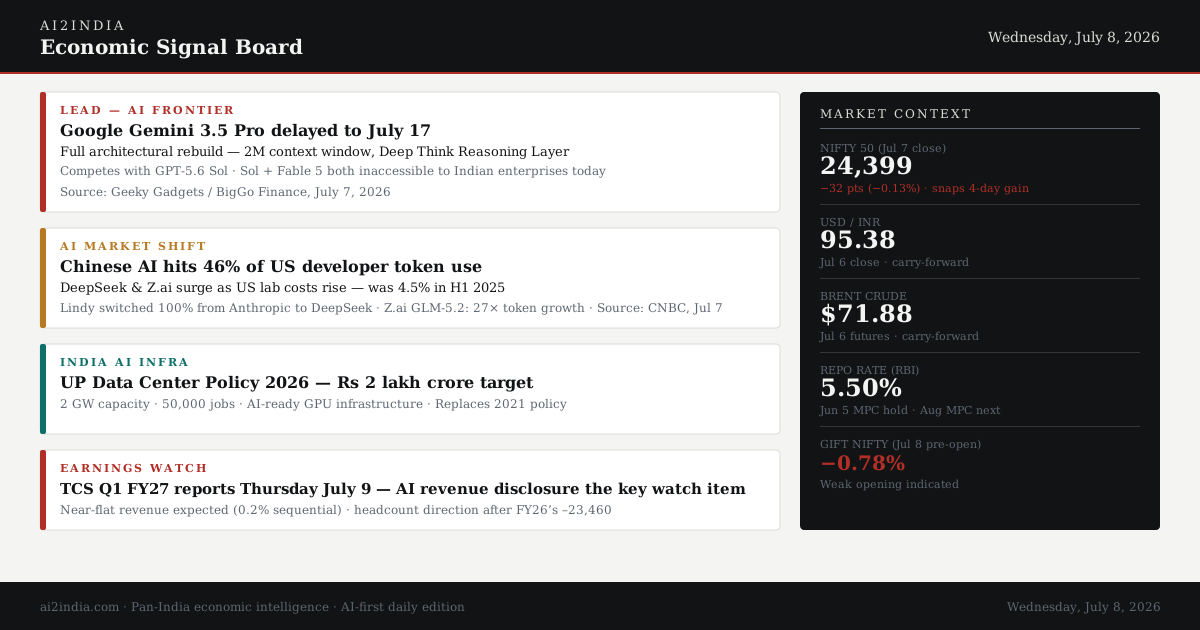
July 8, 2026 signal board: Gemini 3.5 Pro delayed to July 17 for full rebuild; Chinese AI hits 46% of US developer tokens; Nifty 50 24,399 (Jul 7 close); USD/INR 95.38; Brent $71.88/bbl; TCS Q1 FY27 reports July 9
Today’s economic signal board. Full analysis in the Daily Edition.

AI Developments Today

Wednesday, July 8, 2026: three verified AI developments that change what Indian enterprise AI planners must track this week. Google’s Gemini 3.5 Pro architectural rebuild is the most important model-timeline change since GPT-5.6 Sol’s restriction; the Chinese AI market-share surge is the most important cost-and-access signal since DeepSeek V4’s January release; and UP’s data centre policy is India’s most significant state-level AI infrastructure commitment of the year.

DevelopmentSource + DateIndia RelevanceWhat this means for Indian enterpriseStatus
Google DeepMind delays Gemini 3.5 Pro to July 17 after full architectural rebuild — 2-million-token context window, Deep Think Reasoning Layer, improved mathematical reasoning and SVG generation; Nano Banana Pro and Gemini 4 Flash also in pipeline

Google DeepMind announced on July 7, 2026, that the launch of Gemini 3.5 Pro has been delayed to July 17, after the team abandoned the Gemini 2.5 Pro architecture entirely in favour of a complete pre-training rebuild from scratch. The decision reflects internal performance assessment showing the 2.5 Pro base was not competitive with OpenAI’s GPT-5.6 Sol and Anthropic’s Fable 5 on the capability dimensions most valued by enterprise buyers. The rebuilt Gemini 3.5 Pro will feature: a 2-million-token context window (the largest announced by any major frontier lab to date); a Deep Think Reasoning Layer for sustained complex multi-step problem-solving (analogous to GPT-5.6 Sol’s ultra mode but implemented differently); significantly improved mathematical reasoning accuracy; substantially better SVG scene generation (a benchmark Google uses as a proxy for spatial and compositional reasoning); and improved overall image and multimodal output quality. Google is also developing Nano Banana Pro, a specialist image-generation model, and Gemini 4 Flash, a speed-focused high-throughput model — mirroring OpenAI’s three-tier Sol/Terra/Luna structure and confirming that multi-tier model architectures are becoming the industry standard. The architectural rebuild follows a pattern seen in the broader frontier AI race: iterative improvement is being abandoned in favour of fundamental redesign when competitive benchmarks demand it. For Indian enterprise AI planners, the most critical capability is the 2M context window. The current standard for frontier models is 200K–500K tokens (Sonnet 5: 200K; DeepSeek V4-Pro: 128K). A 2M context window eliminates the need for chunking, retrieval-augmented generation overhead, or multi-pass document processing in the following enterprise use cases: full-contract review (typical enterprise contract stack is 50–200K tokens); large regulatory filing analysis; complete codebase comprehension (entire enterprise codebases in context for code review, refactoring, or compliance audit); multilingual document synthesis (entire annual reports, multi-language contract packages); and multi-session conversation memory (eliminating context-window drop-off in long-running AI agents). Each of these is a material productivity improvement for Indian IT services firms, BFSI institutions, and law firms deploying AI. The Deep Think Reasoning Layer is specifically engineered to compete with GPT-5.6 Sol’s ultra multi-agent mode on complex reasoning tasks, targeting: ExploitBench performance (cybersecurity reasoning), mathematical proof verification, and multi-step research synthesis. Both of these capabilities — 2M context and Deep Think — will be available to Indian enterprises from July 17 if general availability is confirmed.
Geeky Gadgets; BigGo Finance “Google Delays Gemini 3.5 Pro Launch to July 17 for Full Architectural Rebuild” (Jul 7, 2026); Google DeepMind blog (Jul 7) Three India dimensions. First, enterprise stack update: Gemini 3.5 Pro on July 17 becomes the first next-generation frontier model accessible to Indian enterprises since the GPT-5.6 Sol access restriction and Fable 5 access closure. It will be the primary upgrade path for Indian enterprises currently using Gemini 2.5 Pro or Gemini Flash in enterprise AI pipelines. The 2M context window is the capability advance that will change the economics of document-heavy AI workflows in Indian IT services, BFSI, and legal sectors. Second, Google Cloud positioning: Indian enterprises running AI on Google Cloud (Vertex AI, Google AI Studio) will get direct access to Gemini 3.5 Pro via their existing Google Cloud agreements — no new procurement required. For IT services firms already on Google Cloud (Infosys, Wipro, Tech Mahindra all have major Google Cloud partnerships), July 17 is a client-delivery capability upgrade, not a procurement event. Third, competitive positioning vs. DeepSeek: Gemini 3.5 Pro’s 2M context window will be its primary competitive advantage over DeepSeek V4-Pro (128K context). For use cases requiring very large context (full-codebase review, large-contract analysis), Gemini 3.5 Pro will be superior. For cost-sensitive volume use cases and self-hosted data-localisation workloads, DeepSeek V4-Flash will remain the preferred option. Update enterprise AI roadmaps immediately: Gemini 3.5 Pro available July 17 — plan evaluation sprint for week of July 20. Priority use cases for 2M context: full-contract review, large codebase analysis, regulatory filing synthesis. For Google Cloud customers: no new procurement; capability is available via existing Vertex AI/Google AI Studio agreements. For teams waiting for a GPT-5.6 Sol alternative: Gemini 3.5 Pro is the nearest accessible candidate; benchmark Deep Think Reasoning Layer vs. Sol’s ultra mode on your specific use cases. Note: Sol general availability (OpenAI) remains on unknown timeline — do not wait for it; plan around Gemini 3.5 Pro as the July 17 frontier capability upgrade. Verified global — Geeky Gadgets; BigGo Finance; Jul 7, 2026
Chinese AI models surge to 30–46% of US developer token usage via OpenRouter — DeepSeek and Z.ai gain ground as OpenAI, Anthropic costs rise; was 4.5% in H1 2025; Lindy switched 100% from Anthropic to DeepSeek; Z.ai GLM-5.2 saw 27× token growth on Vercel; US government considering restrictions

A major analysis published by CNBC on July 7, 2026, drawing on OpenRouter token-level data and interviews with developers and analysts, reveals that Chinese-built AI models now account for 30 to 46% of all developer token usage on OpenRouter — the platform developers use to access multiple AI models — every week since February 8, 2026. The shift is quantitatively dramatic: in the first half of 2025, Chinese AI models averaged 4.5% of OpenRouter token volume. Over the prior 12 months, the average was 11%. Since February 2026, the floor has been above 30%, with peaks at 46%. The models driving this shift are DeepSeek (V4-Pro and V4-Flash) and Z.ai’s GLM-5.2, a model that saw 27-fold daily token volume growth on Vercel (the developer deployment platform) in its first week of availability. AI startup Lindy, which previously ran on Anthropic’s models, moved 100% of its traffic to DeepSeek — a switch it projects will save millions of dollars annually. Brookings Institution fellow Kyle Chan, interviewed by CNBC, framed the driver clearly: “Chinese AI models are particularly attractive to American companies now as AI costs skyrocket. Where previously US companies were prioritising AI adoption regardless of model, now they’re getting more cost-conscious.” The token-level pricing gap is stark: DeepSeek V4-Flash API is approximately $0.14 per million input tokens versus GPT-5.6 Sol at $5 per million (35 times more expensive) and Anthropic Sonnet 5 at $2 per million input (during promotional period, otherwise $3). For tasks that can be handled at DeepSeek-class capability, the economics are overwhelmingly cost-advantaged. The US government’s response is the policy watchpoint: the Trump administration, which requested GPT-5.6 Sol’s staged rollout in June and maintained BIS export controls on Anthropic models until recently, is reportedly considering measures to limit Chinese AI model access in the United States. CNBC notes that this consideration is directly linked to the 30–46% adoption data — regulators view widespread adoption of Chinese AI models as a national-security and data-sovereignty concern.
CNBC “Chinese AI models are gaining ground with U.S. companies as OpenAI, Anthropic costs surge” (Jul 7, 2026); OpenRouter token data; Brookings Institution (Jul 7); Resultsense “Chinese AI models seize up to 46% of US developer use” (Jul 7) Two India dimensions. First, validation of the India enterprise DeepSeek strategy: the CNBC data shows that the cost-driven shift to Chinese open-weight AI is not a fringe developer preference — it is the mainstream enterprise AI procurement pattern in the US. Indian enterprises that adopted DeepSeek V4 for self-hosted regulated-sector workloads or volume API tasks are now in alignment with the production-scale deployment pattern of leading US technology companies. This external validation should accelerate BFSI, healthcare, and government enterprise teams that had been hesitant about DeepSeek adoption due to perceived novelty or supply-chain concern. The supply-chain argument is now harder to sustain: if the model is in production at scale across US enterprises and developer platforms, the operational maturity evidence base is large. Second, US regulatory risk: if the US government introduces access restrictions on Chinese AI models, India will face a decision point — whether to align with US restrictions or maintain independent access. India’s technology relationship with the US (the India–US AI partnership framework) creates pressure to align; India’s cost and sovereignty interests create pressure to maintain access. MeitY will need to take a public position on Chinese AI model access in India if US restrictions materialise. This is a scenario to monitor, not an immediate risk — but enterprise teams in regulated sectors should have contingency plans for a scenario where DeepSeek API access is restricted by policy. For enterprise AI architects: the 30–46% US adoption data is the strongest available validation of the DeepSeek cost-efficiency argument. Use this data in internal governance discussions where DeepSeek adoption is being evaluated — it removes the “untested at enterprise scale” objection. For regulated sectors (BFSI, healthcare, government): continue DeepSeek V4-Flash self-hosted evaluation; the self-hosted architecture specifically addresses both cost and data-localisation requirements and is insulated from any future API access restriction. For policy teams: begin scenario planning for a potential US restriction on Chinese AI model API access; a self-hosted deployment architecture is the hedge. Monitor CNBC, Reuters, and MeitY for first-mover policy signals in coming weeks. Verified global — CNBC; OpenRouter data; Brookings; Jul 7, 2026
Uttar Pradesh Cabinet approves AI-ready Data Center Policy 2026 — Rs 2 lakh crore investment target, 2 GW new capacity, 50,000 jobs; GPU-based, green, AI-ready infrastructure; Rs 21,343 crore already approved under old policy with 644 MW in pipeline

The Uttar Pradesh Cabinet, chaired by Chief Minister Yogi Adityanath, approved the Data Center Policy 2026 on July 7, 2026. The policy replaces the 2021 Data Center Policy, which expired in January 2026, and targets: total investment of more than Rs 2 lakh crore (Rs 2 trillion); additional data centre capacity of 2 gigawatts; creation of 50,000 direct and indirect jobs; and infrastructure standards specifically designed for AI, GPU, and cloud workloads. The policy builds on an already substantial baseline: under the 2021 policy, six data centre parks and two standalone units were approved, with Rs 21,343 crore committed and 644 MW of capacity now under construction across seven live projects. The 2026 policy raises the standard to full AI-readiness: eligibility criteria include GPU cluster integration (rather than CPU-only compute), renewable energy compliance targets (green infrastructure mandate), and high-availability uptime standards consistent with hyperscaler requirements. UP’s geographic advantages for data centre deployment are significant: proximity to Delhi-NCR (the largest enterprise IT consumption market in North India), the existing Delhi–Mumbai Industrial Corridor (DMIC) infrastructure, low land costs relative to Maharashtra and Karnataka, and improving power availability from the UP power sector reform programme. The policy is positioned to compete directly with Maharashtra’s Navi Mumbai data centre cluster, Karnataka’s Bengaluru data centre park, and Telangana’s HITEC City expansion for India’s next generation of AI-workload data centre investment.
Moneycontrol “UP Cabinet approves AI-ready Data Center Policy 2026 with Rs 2 lakh crore investment target” (Jul 7, 2026); CNBC TV18; Times of India (Lucknow); Organiser “Cabinet approves data center policy 2026” (Jul 7) Three India dimensions. First, AI infrastructure competition: UP joining the state-level data centre policy race signals that AI compute infrastructure is now a primary economic development priority for India’s most populous state. The 2 GW target, if achieved, would represent approximately 40% of India’s current total data centre capacity — a transformative addition. For hyperscalers (AWS, Google Cloud, Microsoft Azure) and Indian IT firms considering on-premises or edge AI deployments in North India, UP’s GPU-ready policy framework and competitive land/power costs make it a credible location alternative to existing Bengaluru and Mumbai clusters. Second, sovereign AI relevance: the IndiaAI Mission’s 45,000+ GPU deployment target requires data centre capacity. UP’s AI-ready infrastructure policy directly enables the expansion of compute available to the IndiaAI Mission’s MEITY-managed GPU cluster and to Sarvam AI’s model training infrastructure. Third, GCC implication: Global Capability Centres expanding AI workloads in India (there are now more than 1,700 GCCs in India, per NASSCOM) require AI-grade compute infrastructure. UP’s policy, combined with its existing IT/ITeS ecosystem (Noida, Greater Noida, Lucknow), creates a viable North India GCC AI infrastructure option at scale. Monitor UP’s policy for incentive details (land cost, power tariff, GPU subsidy, tax holiday duration) when the detailed operational framework is published — expected within 60–90 days. For IT services firms evaluating North India expansion: UP’s policy creates a new option alongside existing Delhi-NCR location strategies. For hyperscalers: UP’s 2 GW GPU-ready target warrants a formal site evaluation. For the Sarvam AI/IndiaAI Mission team: UP data centre infrastructure is a near-term compute expansion option for thevam105B training and inference at national scale. Verified India — Moneycontrol; CNBC TV18; Times of India; Jul 7, 2026
Microsoft warns of “more changes” following 4,800 layoffs — AI task automation pattern accelerating at the world’s largest enterprise AI vendor; 267 layoff events in 2026 YTD affecting 185,894 workers (SkillSyncer Jul 7); Intuit 3,000 roles (17% of workforce) cut May 20 to fund AI

The Indian Express reported on July 7 that Microsoft has warned employees of additional restructuring to follow its 4,800-role cut announced July 6 — described as “more changes” in a company-wide communication from senior leadership. The 4,800 cuts (2.1% of global workforce, largest single AI-cited tech layoff of 2026) are now confirmed as a first tranche rather than a one-time event. SkillSyncer’s running tracker shows 267 layoff events in 2026 YTD affecting 185,894 workers globally as of July 7 — a figure that includes both AI-cited and non-AI-cited events. The AI-cited subset (tracked by TechCrunch and Layoffs.fyi) is the more structurally significant: it includes Microsoft (4,800, Jul 6), Oracle (21,000, Jun 22), GitLab (350, Jun 3), and Intuit (3,000, May 20). Intuit’s case is notable: the company cut 17% of its global workforce — including roles in TurboTax, QuickBooks, and Credit Karma product teams — explicitly to reallocate resources toward AI integration. Intuit reported growing revenue and forecast continued gains; the cuts are structural reallocation to AI, not business distress. The pattern across Microsoft, Oracle, GitLab, and Intuit is consistent: record revenues + AI-cited workforce restructuring = AI is generating measurable productivity at scale across software, enterprise technology, and financial software verticals.
Indian Express “Microsoft warns of more changes after 4,800 layoffs amid broader restructuring” (Jul 7, 2026); SkillSyncer layoff tracker (Jul 7, 2026); TechCrunch running list; News18 “Every Big Tech Layoff in 2026 That Blamed AI” (Jul 7); Intuit press release (May 20, 2026) India dimension: Microsoft’s “more changes” warning is the first public indication that the 4,800-role announcement was a tranche, not a total. Microsoft India (headquartered in Hyderabad, with major operations in Bengaluru and Pune) is among Microsoft’s largest non-US engineering and support centres. If subsequent restructuring tranches include India-based roles — which Microsoft has not confirmed — the India impact would be material. India IT services firms that are Microsoft implementation partners (TCS, Infosys, Wipro, HCLTech, Cognizant) should monitor client IT spend signals from Microsoft enterprise customers: if Microsoft’s AI-driven productivity gains reduce its customers’ need for IT services headcount, downstream demand reduction is a secondary risk. The Intuit 3,000-role cut (May 20) is particularly relevant for India’s FinTech sector: Intuit’s products (QuickBooks, TurboTax) are used by Indian SMEs and accounting professionals; the AI integration that drove those cuts will arrive in the India market through Intuit’s India product offerings. Monitor Microsoft India communications for any indication of India-specific restructuring in coming weeks. For Microsoft partner firms (TCS, Infosys, HCLTech, Wipro, Cognizant): review Microsoft customer AI adoption rates — if clients are reducing IT services spend because AI is handling tasks previously outsourced to Indian IT firms, that signal will appear in Q2 FY27 client conversations before it appears in revenue data. For FinTech teams: track Intuit India product updates post-AI-integration for productivity benchmark data relevant to Indian financial software workflows. Verified global — Indian Express; SkillSyncer; TechCrunch; Jul 7, 2026

India AI Ecosystem

Wednesday, July 8, 2026: India’s AI ecosystem enters earnings season eve with UP’s Rs 2 lakh crore data centre policy as the week’s domestic policy signal. The frontier access gap (Sol locked, Fable 5 closed, Gemini 3.5 Pro delayed to July 17) continues to strengthen the structural case for India-domiciled AI (Sarvam, IndiaAI Mission) and validated open-weight self-hosted alternatives (DeepSeek V4). TCS results tomorrow will provide the first hard AI revenue data point of Q1 FY27 earnings season.

Platform / OrganisationDevelopmentIndia AI SignificanceStatus
TCS — Q1 FY27 July 9; AI strategy + headcount the key items
India’s largest IT exporter
FY26 headcount: –23,460
Multiple brokerage previews
Post-market results (3:30 PM+)
Multiple brokerage previews published July 7–8 confirm near-consensus on the Q1 FY27 picture: near-flat sequential dollar revenue growth (consensus ~0.2%, range 0–0.5%); wage hike absorption (TCS applies hikes effective July 1) weighing on margins; cautious client discretionary spending; weak deal ramp-up in traditional IT. Moneycontrol identifies five watch items: AI strategy updates; hiring plans; FY27 discretionary spending; attrition trends; deal pipeline composition. FortuneIndia characterises the earnings season as “sombre” with the weakest sequential showing from Wipro (–1.3% q/q) and strongest from Tech Mahindra (+1%). TCS’s Q1 report is specifically watched for: (1) any explicit AI services revenue percentage disclosure — the first hard data against NASSCOM’s $10–12B India IT AI services projection; (2) headcount direction after FY26’s net –23,460 — Q1 FY27 net headcount change is the single most watched India IT workforce signal; (3) GenAI deal pipeline size — specifically whether NASSCOM’s stated deal win acceleration is visible at TCS’s individual company level; (4) Q2 guidance and FY27 full-year outlook revision. NDTV Profit notes salary hike absorption, hiring, and attrition alongside AI as the four earnings call topics analysts will press hardest on. TCS Q1 FY27 is the most important India AI data event of the week. Any AI revenue disclosure will be the first empirical data point against NASSCOM’s $10–12B projection. Set a research alert for post-market July 9. Review the earnings call transcript for: AI services as % of revenue; headcount Q4 FY26 vs. Q1 FY27; GenAI deal wins by vertical; Q2 guidance tone (confident vs. cautious). The TCS result sets the narrative for Infosys (Jul 16–17), HCLTech, and Wipro results in the following two weeks. Verified signal — Moneycontrol; Business Standard; NDTV Profit; Jul 7–8, 2026
Sarvam AI — thevam105B; India’s sovereign frontier model
$1.5B valuation
HCLTech 10.46%
India govt 1–2% equity
10M API calls/day
IndiaAI Mission compute
No new Sarvam AI announcement today. Context update: UP’s AI-ready Data Center Policy 2026 (Rs 2 lakh crore, 2 GW capacity) is a structural tailwind for Sarvam’s compute expansion plans. The IndiaAI Mission’s 45,000+ GPU deployment — Sarvam’s primary training compute resource — requires exactly the GPU-ready, high-availability data centre infrastructure that UP’s policy is designed to attract. Additionally, the Chinese AI adoption data (CNBC) reinforces Sarvam’s strategic position: as US companies adopt Chinese AI models at 30–46% market share, US regulators are increasingly motivated to restrict Chinese AI access, which creates pressure on India to develop sovereign alternatives. Sarvam’s thevam105B remains India’s only domestically hosted, India-developed frontier-class model — the sole option for Indian regulated sectors requiring both frontier capability and data-localisation without dependence on either US or Chinese supply chains. ICAI–Sarvam MoU (50,000+ chartered accountants AI upskilling programme) and HCLTech’s 10.46% equity stake (which will be discussed at HCLTech Q1 FY27 results mid-July) are the near-term ecosystem signals to watch. Monitor Sarvam AI for: model capability announcements relative to Gemini 3.5 Pro’s July 17 launch (2M context comparison); API pricing updates; data centre partnership with UP (if any); and HCLTech Q1 FY27 earnings commentary on the Sarvam stake strategic value. The Chinese AI adoption story strengthens Sarvam’s US government-backed sovereign model argument — watch for any Sarvam positioning statement on this topic. Verified India (baseline) — carry-forward with UP policy context update
India IT sector: Rs 17 lakh crore market cap erosion; Gift Nifty –0.78% ahead of Q1 FY27 season; Wipro –54%, LTIMindtree –53% from peaks; AI pricing pressure the structural driver
Nifty IT under-performing Nifty 50
Sensex down 104 pts (Jul 7)
TCS results the near-term catalyst
Gift Nifty is down 0.78% as of July 8 pre-open, signalling a weak opening for domestic equities. Nifty 50 closed July 7 at 24,399 (down 32 points, snapping a four-day gaining streak). Sensex closed at approximately 78,181 (down 104 points). Strong IT buying on July 7 partially offset the broader decline, suggesting some pre-results positioning in IT stocks ahead of TCS Q1 FY27 (July 9). The Rs 17 lakh crore Nifty IT market cap erosion context remains unchanged: Wipro is down 54% from peak, LTIMindtree down 53%, with HCLTech, Persistent, Mphasis, and Tech Mahindra all significantly below peak valuations. The market is pricing in AI disruption risk to India IT business models at scale. The structural driver — AI-led pricing pressure (clients expect cheaper outcomes from AI-augmented delivery) combined with weak global discretionary IT spending — is not expected to reverse in Q1 FY27. The question TCS’s results will answer is whether AI services revenue is growing fast enough to offset traditional pricing compression — and whether the pace of offset is accelerating. The weak Gift Nifty (–0.78%) and flat Nifty 50 context suggest limited pre-results enthusiasm. If TCS delivers a positive surprise on AI revenue or guidance, the Nifty IT re-rating potential is significant given how far the sector has fallen from peak. Conversely, a muted result confirming market consensus will likely extend the Nifty IT underperformance vs. broader Nifty 50. Track Nifty IT vs Nifty 50 relative performance on July 9 post-market as the leading indicator for sector sentiment heading into the full Q1 FY27 season. Verified India — Moneycontrol; HinduBusinessLine; 5paisa; Jul 7–8, 2026
Carry-forward: HCLTech $1.14B AI deal; Krutrim cloud pivot; OpenAI India MD Prabhjeet Singh; MeitY AI law; NASSCOM AI; IndiaAI Mission; Infosys Topaz; Wipro AI360; Zoho AI; Freshworks Freddy All carry-forward items unchanged from July 7 edition. Key context update for July 8: the Chinese AI cost story (CNBC) directly validates the enterprise AI cost-efficiency case being made by Infosys Topaz, Wipro AI360, and TCS AI Cloud — if US enterprise AI buyers are shifting to DeepSeek at scale for cost reasons, Indian IT services firms selling AI efficiency services face heightened competition from commoditised open-weight models in their existing client base. The counter-argument: Indian IT services firms add value through integration, customisation, regulatory compliance, and support — the model itself being cheap does not eliminate the service layer. However, if AI services margins compress because the underlying model is DeepSeek at $0.14/M rather than GPT-5.6 Sol at $5/M, the AI services revenue picture for Q1 FY27 may be lower-margin than NASSCOM projections anticipated. HCLTech’s $1.14B deal and its contractual structure will be the reference case for whether premium AI services pricing is sustainable at the current model cost environment. The Chinese AI cost signal is the most important new input for India IT services AI pricing strategy. Monitor Q1 FY27 earnings calls for any commentary on AI services margin vs. model cost dynamics — this will be a key analyst question for TCS, Infosys, and HCLTech. Verified India — Multiple; Jun–Jul 2026 (carry-forward)

AI Adoption Impact

July 8: The dominant AI adoption story is the frontier access gap deepening (Sol locked, Fable 5 closed, Gemini 3.5 Pro delayed to July 17) combined with the Chinese open-weight cost signal validating the self-hosted alternative. Indian enterprises face the widest gap between frontier AI capability and what they can access since the access restriction cycle began in June 2026 — and the market is already compensating by moving to Chinese open-weight models at production scale.

AI Impact DimensionEvidenceTrajectory
Frontier AI access gap at widest point for Indian enterprises: Sol locked (~20 US orgs), Fable 5 closed (Jul 7), Gemini 3.5 Pro delayed to Jul 17 — three consecutive frontier model constraints in five weeks OpenAI blog + Help Center (Jun 25–Jul 3, 2026); Geeky Gadgets (Jul 5–7, 2026); BigGo Finance (Jul 7). Timeline: Jun 25: GPT-5.6 Sol restricted to ~20 US govt orgs; Jul 7: Fable 5 select-plan access window closes; Jul 7: Gemini 3.5 Pro delayed from June to July 17. Available to Indian enterprises now: Sonnet 5 ($2/M input, through Aug 31 promotional); Gemini 3.5 Flash (current gen, accessible); DeepSeek V4-Flash API ($0.14/M) or self-hosted; older Mythos (access restored per The Guardian, Jul 1). Available July 17: Gemini 3.5 Pro (full rebuild, 2M context, Deep Think). Available on unknown timeline: GPT-5.6 Sol (OpenAI: “coming weeks” as of Jul 3). Five-week gap assessment: Indian enterprises are operating on Sonnet 5 / Gemini Flash / DeepSeek as their frontier stack — all capable, all accessible — but missing GPT-5.6 Sol’s ultra multi-agent mode and ExploitBench performance, and Fable 5’s next-gen reasoning capabilities. → Partially resolving Jul 17 (Gemini 3.5 Pro accessible); GPT-5.6 Sol timeline unknown but expected within weeks per OpenAI; the five-week access constraint has validated the multi-provider architecture strategy for Indian enterprise AI teams that maintained provider diversity
Chinese AI open-weight cost advantage validated at US production scale: 30–46% OpenRouter developer share; enterprises switching from Anthropic/OpenAI at millions-of-dollars annual savings; India self-hosted DeepSeek strategy externally confirmed CNBC (Jul 7, 2026); OpenRouter token data; Brookings. DeepSeek V4-Flash: ~$0.14/M input tokens. GPT-5.6 Sol: $5/M input (35× more expensive). Sonnet 5 promotional: $2/M (14× more expensive). Gemini 3.5 Flash: ~$0.10–0.15/M (comparable). DeepSeek V4-Pro: API ~$0.28/M; self-hosted: compute-only (no per-token API cost). Z.ai GLM-5.2: 27× token volume growth in first week on Vercel. Lindy: 100% switch from Anthropic models to DeepSeek, saving millions annually. OpenRouter share: floor 30%, peak 46% (since Feb 8, 2026) vs. 4.5% H1 2025 average. US government considering Chinese AI access restrictions — policy risk for API-based DeepSeek access but not for self-hosted. India AI-specific: DeepSeek V4-Flash self-hosted eliminates API access restriction risk; MIT licence permits commercial deployment on-premises. ↑ Chinese open-weight cost advantage structurally entrenched; US market adoption data removes the novelty objection for Indian enterprise adopters; US regulatory response is the primary risk variable; self-hosted architecture remains the India-optimised hedge against both cost and policy risk
AI-driven workforce restructuring: 185,894 workers affected in 267 layoff events (2026 YTD); Microsoft warns “more changes” post-4,800; India AI hiring at 16% of IT vacancies (50% talent shortfall) SkillSyncer (Jul 7, 2026); Indian Express (Jul 7); TechCrunch (Jul 6); Naukri.com (Jul 3). Global layoffs 2026 YTD: 267 events, 185,894 workers (SkillSyncer Jul 7). AI-cited subset: 120,000+ (Layoffs.fyi). Microsoft: 4,800 (Jul 6) + “more changes” warning (Jul 7); Intuit: 3,000 (May 20, 17% of workforce); Oracle: 21,000 (Jun 22, 13%); GitLab: 350 (Jun 3, 14%). India AI hiring paradox: 16% of India IT vacancies are AI-specific (Jul 2026), +16% YoY AI hiring vs. –3% overall IT; talent shortfall 50% (4.2 lakh available vs. 6 lakh demand). Microsoft warning of “more changes”: first public multi-tranche restructuring signal of 2026 — suggests AI-driven restructuring has not reached its endpoint at any of the major tech employers. ↑ AI restructuring pace accelerating; 267 events in seven months exceeds 2025 full-year pace; India IT workforce bifurcation (AI-skilled: demand accelerating; AI-displaced: at risk) is deepening; TCS Q1 FY27 headcount disclosure tomorrow is the India benchmark for whether major IT employer restructuring is accelerating or stabilising
India AI infrastructure build-out: UP Data Center Policy Rs 2 lakh crore target signals state-level competition for AI compute investment; IndiaAI Mission 45,000+ GPU deployment underpins sovereign model capacity Moneycontrol; CNBC TV18; Times of India (Jul 7, 2026). UP policy: Rs 2 lakh crore target; 2 GW capacity; 50,000 jobs; GPU-ready, green infrastructure. Under old 2021 policy: Rs 21,343 crore committed, 644 MW in pipeline. State competition: Maharashtra, Karnataka, Telangana (existing); UP (new). IndiaAI Mission 45,000+ GPUs: MEITY managed; Sarvam thevam105B primary user. NASSCOM 1,700+ GCCs in India: AI-workload data centre demand growing at GCC expansion pace (~7–9% YoY per NASSCOM). Data centre capacity constraint: current India total is approximately 1 GW operational; UP’s 2 GW target would roughly triple national capacity over 5–7 years. ↑ India AI compute infrastructure trajectory accelerating; state-level competition driving faster deployment than central policy alone would achieve; GCC and hyperscaler demand drivers are durable; 2 GW UP target is aspirational but credible given the Rs 21,343 crore baseline already committed; bottleneck is now power availability and skilled facility management workforce, not policy intent

Five Things That Changed

Wednesday, July 8, 2026: two global AI developments (Gemini 3.5 Pro delayed to July 17; Chinese AI 46% of US developer tokens), one India AI infrastructure signal (UP data centre Rs 2 lakh crore), one earnings countdown (TCS Q1 FY27 tomorrow), one workforce signal (Microsoft warns more changes; 185,894 workers in 267 2026 events).

SignalData PointReader ImpactStatus
Google Gemini 3.5 Pro delayed to July 17 — full architectural rebuild; 2M context window; Deep Think Reasoning Layer; Nano Banana Pro and Gemini 4 Flash also coming; Google competing directly with GPT-5.6 Sol BigGo Finance; Geeky Gadgets (Jul 7, 2026). Gemini 2.5 Pro architecture scrapped; full pre-training rebuild. Target: 2M token context (largest announced); Deep Think Reasoning Layer (complex multi-step); improved math reasoning; better SVG generation; improved multimodal. Also: Nano Banana Pro (image gen); Gemini 4 Flash (speed/throughput). Competing against: GPT-5.6 Sol (locked, no India access) and Fable 5 (closed Jul 7). India access: expected July 17 via Google Cloud Vertex AI and Google AI Studio — no new procurement required for existing Google Cloud customers. Current Gemini 3.5 Flash: accessible, recommended for high-volume tasks — will coexist with 3.5 Pro. Add July 17 to enterprise AI evaluation calendar immediately. Priority benchmark tasks: (1) 2M context window test on your largest document workflow; (2) Deep Think Reasoning Layer vs. Sonnet 5 on complex multi-step reasoning use cases; (3) SVG/visual generation for reporting and document automation. For Google Cloud customers: Gemini 3.5 Pro arrives via existing agreement — brief your enterprise AI architects on the capability upgrade before July 17 so evaluation begins day one. This is the first accessible frontier-class model upgrade since the access restriction cycle began June 25. Verified global — BigGo Finance; Geeky Gadgets; Jul 7, 2026
Chinese AI models hit 30–46% of US developer token use — DeepSeek and Z.ai surge as US lab costs rise; validates India enterprise DeepSeek strategy; US regulatory response imminent CNBC (Jul 7, 2026); OpenRouter data; Brookings. OpenRouter Chinese AI share: above 30% every week since Feb 8, 2026; peak 46%; prior 12-month average 11%; H1 2025 average 4.5%. Z.ai GLM-5.2: 27× token growth on Vercel in first week. Lindy: 100% switch from Anthropic to DeepSeek, “saving millions.” DeepSeek V4-Flash: ~$0.14/M input vs. GPT-5.6 Sol $5/M (35× cheaper). US govt considering Chinese AI access restrictions. India note: DeepSeek V4 self-hosted (MIT licence) avoids API access risk and is India-localised. Use CNBC/OpenRouter data in internal AI cost governance discussions — removes the “only Indian enterprises consider DeepSeek” objection. For regulated sectors: accelerate DeepSeek V4-Flash self-hosted evaluation specifically for workloads currently on expensive US lab APIs. Begin scenario planning for potential US restriction on Chinese AI model access (low probability near-term but strategic risk to monitor). The self-hosted architecture is the hedge: MIT licence + on-premises = independent of both US lab pricing and potential Chinese API restrictions. Verified global — CNBC; OpenRouter; Brookings; Jul 7, 2026
UP Data Center Policy 2026: Rs 2 lakh crore investment, 2 GW capacity, 50,000 jobs — GPU-ready, green infrastructure; UP joins state-level AI compute race Moneycontrol; CNBC TV18; Times of India; Organiser (Jul 7, 2026). Cabinet approved Jul 7 under CM Yogi Adityanath. Target: Rs 2L crore+; 2 GW+; 50,000 jobs. Replaces 2021 policy (expired Jan 2026). Old policy baseline: Rs 21,343 crore committed; 644 MW; six data centre parks + two standalone units; seven projects under construction. New policy differentiators: GPU cluster integration eligibility; renewable energy compliance; AI-ready specifications. Competition: Maharashtra Navi Mumbai cluster; Karnataka Bengaluru park; Telangana HITEC City expansion. UP advantages: Delhi-NCR proximity; DMIC infrastructure; lower land/power costs vs. southern metros. For hyperscalers and GCC operators: UP’s AI-ready policy creates a credible North India data centre option at scale — initiate site evaluation process when detailed policy incentives are published (60–90 days). For India AI infrastructure investors: UP’s GPU-ready criteria signal that state-level policy is now explicitly targeting AI-workload infrastructure, not legacy IT compute. For IndiaAI Mission / Sarvam AI: UP data centre expansion is a near-term training and inference compute option that does not depend on a single state’s power grid. Verified India — Moneycontrol; Times of India; Jul 7, 2026
TCS Q1 FY27 reports tomorrow (July 9, post-market) — AI revenue disclosure is the single biggest watch item; near-flat sequential growth expected; Rs 17 lakh crore Nifty IT erosion; Gift Nifty –0.78% signals weak July 8 open Moneycontrol; Business Standard; NDTV Profit; FortuneIndia (Jul 7–8, 2026). TCS announces July 9 after 3:30 PM. Consensus: 0.2% sequential dollar revenue growth; margin pressure from Jul 1 wage hikes; cautious demand. Watch items: AI/GenAI deal pipeline; headcount (FY26: –23,460 net); Q2 guidance; FY27 full-year outlook. Brokerages: “weakest Q1 in three years for large-cap IT.” Market context: Nifty 50 closed Jul 7 at 24,399 (–32 pts); Sensex 78,181 (–104 pts); Gift Nifty –0.78%; Nifty IT underperforming Nifty 50 by wide margin (Rs 17L cr erosion); strong IT buying on Jul 7 suggests some pre-results positioning. Kotak: TCS preferred large-cap. Set post-market research alert for July 9. TCS AI revenue disclosure — however partial — will be the first empirical India IT AI revenue data point of 2026 earnings season. Review earnings call transcript for: (1) AI services as explicit % of revenue; (2) Q1 headcount vs. Q4 FY26; (3) GenAI deal wins by sector; (4) Q2 guidance tone; (5) any mention of DeepSeek / Chinese AI cost-competition in client conversations. TCS guidance sets the narrative for Infosys (Jul 16–17), HCLTech, and Wipro results to follow. Verified signal — Moneycontrol; Business Standard; NDTV Profit; Jul 8, 2026
Microsoft warns “more changes” post-4,800 layoffs — 185,894 workers affected in 267 events in 2026 YTD; Intuit cut 17% (3,000 roles) to fund AI; AI-driven restructuring pattern extends beyond single-tranche events Indian Express (Jul 7, 2026); SkillSyncer (Jul 7); TechCrunch; News18. Microsoft: 4,800 Jul 6 + “more changes” warning Jul 7 — first multi-tranche restructuring signal. SkillSyncer 2026 YTD: 267 events, 185,894 workers (as of Jul 7). AI-cited sub-total: 120,000+ (Layoffs.fyi). Intuit (May 20): 3,000 roles (17% of workforce), TurboTax/QuickBooks/Credit Karma teams restructured to fund AI — company reporting growing revenue throughout. Pattern: Oracle 21,000 + Intuit 3,000 + Microsoft 4,800 all report growing revenue alongside workforce cuts — AI-productivity-driven restructuring distinct from business-distress layoffs. India: 7.16% of global AI-driven tech layoffs H1 2026 (ETV Bharat Jul 6); EdTech and FinTech most affected; IT services avoiding mass cuts but not backfilling departures. The “more changes” signal from Microsoft makes it the first major tech employer to explicitly telegraph multi-tranche AI-driven restructuring in 2026. Model this as a leading indicator for India IT services partner firms: if Microsoft clients are reducing IT budgets alongside their own workforce restructuring, downstream demand reduction in IT services contracts is a Q2–Q3 FY27 risk. For HR and workforce planning: the combination of 185,894 global workers affected + Microsoft’s “more changes” warning is the strongest available signal that 2026 AI-driven restructuring has not peaked. Run your organisation’s AI task automation exposure map now — before forced restructuring, not after. Verified global — Indian Express; SkillSyncer; TechCrunch; Jul 7, 2026

Data Variables Ledger

Key numbers as of July 8, 2026 (7:00 AM IST). Market data reflects July 7 close; model pricing current at publication.

VariableValueSource / DateDirection
Gemini 3.5 Pro launch dateJuly 17, 2026 (delayed from June)BigGo Finance; Geeky Gadgets (Jul 7, 2026)Full architectural rebuild; 2M context window; Deep Think Reasoning Layer; new pre-training cycle
GPT-5.6 Sol pricing (when accessible)$5 input / $30 output per 1M tokensOpenAI blog (Jun 25–26, 2026)Locked to ~20 US govt-vetted orgs; no GA date; India enterprise access: not available
GPT-5.6 Terra pricing$2.50 input / $15 output per 1M tokensOpenAI (Jun 25–26, 2026)GPT-5.5 competitive capability at ~half price; India access: not yet available
GPT-5.6 Luna pricing$1 input / $6 output per 1M tokensOpenAI (Jun 25–26, 2026)High-throughput, cost-optimised; India access: not yet available
Sonnet 5 (Anthropic) — promotional$2 input / $12 output per 1M tokensAnthropic pricing page (through Aug 31, 2026)Accessible India; recommended for agentic tasks; promotional window through Aug 31
DeepSeek V4-Flash API price~$0.14 input / $0.28 output per 1M tokensDeepSeek pricing (Jul 2026)85% cheaper than GPT-5.5; MIT licence; self-hostable; 30–46% of US OpenRouter tokens
Chinese AI models — US OpenRouter share30–46% of weekly developer tokens (Feb–Jul 2026)CNBC; OpenRouter (Jul 7, 2026)Up from 4.5% H1 2025; DeepSeek + Z.ai leading; US govt considering restrictions
Nifty 5024,399.08 (Jul 7 close)Moneycontrol; NSE (Jul 7, 2026)−32.27 pts (−0.13%); snaps 4-day gain; Gift Nifty −0.78% for Jul 8 open
Sensex78,181.45 (Jul 7 close)BSE; Moneycontrol (Jul 7, 2026)−103.62 pts; strong IT buying partially offset broader weakness
USD / INR95.38 (Jul 6 close; carry-forward)Moneycontrol (Jul 6, 2026)Jul 7 range est. 95.25–95.55; DXY firmness; RBI managed float
Brent crude$71.88/bbl (Jul 6 futures; carry-forward)Reuters (Jul 6, 2026)−0.33%; OPEC+ balanced; US–Iran muted; India import-cost tailwind continues
Repo rate (RBI)5.50%RBI MPC Jun 5, 2026Hold; Aug MPC next live window; inflation benign; carry-forward
Nifty IT market cap erosion (from peak)Rs 17 lakh croreEconomic Times (Jul 6, 2026)Wipro –54%; LTIMindtree –53%; structural AI pricing pressure; TCS Q1 FY27 Jul 9 catalyst
India AI vacancy share (Naukri.com)16% of total IT vacancies (Jul 2026)Naukri.com; ETV Bharat (Jul 3–6, 2026)Up from 2.9% (Jan 2023); +16% YoY AI hiring vs. –3% overall IT; 50% talent shortfall
Global AI-cited tech layoffs (2026 YTD)267 events; 185,894 workersSkillSyncer (Jul 7, 2026)AI-cited subset: 120,000+ (Layoffs.fyi); Microsoft warns “more changes” post-4,800
UP Data Center Policy 2026Rs 2 lakh crore investment target; 2 GW; 50,000 jobsMoneycontrol; Times of India (Jul 7, 2026)New; GPU-ready, green; replaces 2021 policy; Rs 21,343 cr baseline already committed

Verified Layoff Radar

India-confirmed developments only. AI-driven restructuring flagged separately from general cost cuts. No new India-specific layoff announcements today; carry-forward verified items from prior editions. Global context: 267 layoff events, 185,894 workers affected in 2026 YTD (SkillSyncer, Jul 7).

CompanyAnnouncedIndia ImpactGlobal ImpactAI-Driven?SourceStatus
Microsoft Jul 6, 2026; “more changes” warned Jul 7 India headcount not specified; Microsoft India (Hyderabad HQ, Bengaluru, Pune); monitoring for subsequent tranche India disclosure 4,800 roles; 2.1% of global workforce; first tranche per “more changes” warning Yes — “AI is changing how work gets done” (Microsoft blog) TechCrunch; Microsoft blog; Indian Express (Jul 6–7, 2026) Verified global — India impact unconfirmed; monitoring
Oracle Jun 22, 2026 (SEC filing) India headcount not broken out; Oracle India (Bengaluru, Hyderabad); AI adoption cited as driver; monitoring 21,000 roles over 12 months; 13% of global workforce decline Yes — AI adoption cited in 10-K SEC filing Oracle 10-K; SEC.gov (Jun 22, 2026) Verified global — India split not disclosed
Intuit May 20, 2026 India operations not specified; Intuit India (Bengaluru engineering centre); monitoring for India headcount disclosure ~3,000 roles; 17% of global workforce; TurboTax, QuickBooks, Credit Karma teams Yes — “restructuring to reduce complexity and reallocate resources toward AI” (Intuit press release) TechCrunch; News18; Intuit press release (May 20, 2026) Verified global — India split not disclosed
GitLab Jun 3, 2026 India roles not specified; GitLab India (remote-first); monitoring ~350 roles; 14% of global staff; to fund AI infrastructure and handle AI-driven workflow traffic growth Yes — AI infrastructure investment cited GitLab press release (Jun 3, 2026) Verified global — India split not disclosed
TCS FY26 annual report (net –23,460 headcount; no mass layoff announcement) All India; TCS’s headcount reduction is via hiring freeze and non-replacement, not announced layoffs; Q1 FY27 direction disclosed July 9 FY26 net: –23,460 (headcount reduction, not a single announced event) Indirect — AI-augmented delivery reducing headcount demand; no direct AI-cited announcement TCS FY26 Annual Report; BusinessToday; Moneycontrol (Jul 2026) Verified India — non-replacement not layoff; Q1 FY27 direction July 9

Hiring Demand Watch

AI/ML and data roles dominate demand. UP Data Center Policy 2026 adds a 50,000-job target to India’s AI infrastructure hiring pipeline. The structural 50% AI talent shortfall (4.2 lakh available vs. 6 lakh demand) continues.

Role CategoryDemand SignalSourceIndia Context
AI/ML Engineers 16% of all India IT vacancies are AI-specific (Jul 2026); +16% YoY AI hiring vs. –3% overall IT; demand at 6 lakh, supply 4.2 lakh (50% shortfall) Naukri.com; ETV Bharat (Jul 3–6, 2026) Demand 2.5× global average (Stanford AI Index); entry-level hiring worst affected; AI auditors and compliance specialists as new high-demand categories
Data Centre / GPU Infrastructure Engineers UP Data Center Policy 2026: 50,000 direct and indirect jobs targeted; GPU cluster integration as new mandatory eligibility criterion Moneycontrol; Organiser (Jul 7, 2026) New demand category: GPU-ready data centre operations, AI infrastructure management, green computing specialists; India’s existing 644 MW pipeline already employing; 2 GW expansion creates structural demand surge in this category over 5–7 years
AI Services / Indian IT firms TCS Q1 FY27 headcount direction July 9 — after FY26 net –23,460; Wipro AI360, HCLTech AI Force, Infosys Topaz all actively hiring AI talent while reducing traditional IT headcount TCS FY26 Annual Report; NDTV Profit; Business Standard (Jul 7–8, 2026) Bifurcation: AI-skilled IT professionals in demand at premium wages; traditional IT (testing, maintenance, basic dev) headcount declining; Q1 FY27 earnings season will reveal net direction at each major IT employer
AI/ML roles in non-IT sectors AI and automation roles in FMCG, insurance, retail up to +25% YoY (Jul 2026) Naukri.com; ETV Bharat (Jul 6, 2026) AI demand spreading beyond IT services into India’s broader economy; FMCG AI (supply chain optimisation, demand forecasting), insurance AI (underwriting automation), retail AI (personalisation, inventory) are the fastest-growing non-IT AI hiring segments
AI Reskilling programmes (ICAI–Sarvam; India–Japan AI pact) ICAI–Sarvam MoU: 50,000+ chartered accountants; India–Japan AI pact: 500 AI professionals to Japan by 2030 ICAI; Government of India (Jun–Jul 2026) Supply-side interventions addressing the 50% talent shortfall; ICAI programme most immediately scalable (50,000 members in structured reskilling); Japan pipeline creates international AI talent export pathway alongside domestic demand growth

Real Estate Pulse

GCC and AI company office activity only. UP Data Center Policy 2026 is the primary real estate signal today — a large-scale land and infrastructure allocation event. No new GCC leasing announcements today.

Market SegmentSignalSourceStatus
UP Data Centre Land / Infrastructure UP Cabinet approved Data Center Policy 2026 on Jul 7; 2 GW+ capacity target; GPU-ready parks; Delhi-NCR proximity; lower land costs than Bengaluru/Mumbai; DMIC infrastructure advantage. Old policy: six data centre parks and two standalone units approved, seven projects under construction. New policy: higher AI-readiness eligibility criteria create demand for larger, better-specified data centre campuses Moneycontrol; Times of India (Jul 7, 2026) Verified India — policy approved Jul 7; site allocations and developer engagement to follow in 60–90 days
GCC AI office leasing (carry-forward) 1,700+ GCCs in India (NASSCOM); GCC office leasing at record pace in Hyderabad, Bengaluru, Pune; AI-workload GCCs require GPU-ready colocation or build-to-suit — UP policy creates a North India alternative; no new leasing announcements today NASSCOM (Jul 2026); carry-forward Verified signal — carry-forward; UP policy adds North India option for GCC AI infrastructure
Sarvam AI / IndiaAI Mission compute expansion (carry-forward) IndiaAI Mission 45,000+ GPU deployment; Sarvam thevam105B primary beneficiary; UP’s AI-ready data centre policy creates a potential expansion site for MEITY-managed GPU clusters; no formal partnership announced MeitY; IndiaAI Mission (carry-forward) Watchlist — UP policy creates structural option; formal engagement not confirmed

Market Signals

Four key indicators as of July 7, 2026 close (latest available at 7:00 AM IST July 8). Nifty IT context: Rs 17 lakh crore market cap erosion; Gift Nifty –0.78% signals weak July 8 open; TCS Q1 FY27 post-market July 9 is the week’s primary catalyst.

Nifty 5024,399Jul 7 close · −32 pts · snaps 4-day gain · Sensex 78,181 (−104) · strong IT buying · Gift Nifty −0.78%
USD / INR95.38Jul 6 close (carry-forward) · range 95.25–95.55 · DXY firmness · RBI managed float
Brent Crude$71.88Jul 6 futures (carry-forward) · −0.33% · OPEC+ balanced · India import-cost tailwind
Repo Rate (RBI)5.50%Jun 5 MPC hold · Aug MPC next · inflation benign · carry-forward

Forecast Tracker Updates

Active predictions with evidence notes updated as of July 8, 2026. No new forecasts added today — existing predictions carry with new data points below.

ForecastMadeTarget DateEvidence Update (Jul 8)Status
Nifty IT underperforms Nifty 50 through Q1 FY27 earnings season due to AI disruption pricing; Rs 17 lakh crore erosion continues until AI revenue disclosure provides positive surprise Jul 3, 2026 Jul 9–25, 2026 (Q1 FY27 season) Jul 8 update: Nifty 50 Jul 7 close 24,399 (–32); strong IT buying partially offsets; Gift Nifty –0.78% confirms continued weakness. Wipro –54%, LTIMindtree –53% from peaks. Pre-results positioning in IT stocks on Jul 7 (strong IT buying) is insufficient to reverse the structural underperformance. TCS results (Jul 9) are the first test of this forecast: a positive AI revenue surprise would challenge the forecast; consensus sombre result would confirm it through at least the Infosys (Jul 16–17) and HCLTech results. Active — on track; TCS Jul 9 is next verification event
GPT-5.6 Sol reaches general availability for Indian enterprises within 4–6 weeks of June 25 restriction announcement (by approximately August 6–August 20, 2026) Jul 3, 2026 Aug 6–20, 2026 Jul 8 update: OpenAI stated “coming weeks” as of Jul 3; no update as of Jul 8. Gemini 3.5 Pro delayed to Jul 17 — Google rebuild suggests that the Sol GA timeline may face its own competitive considerations (OpenAI may want Sol accessible before Gemini 3.5 Pro captures enterprise attention). Chinese AI 30–46% OpenRouter share creates additional commercial urgency for OpenAI to accelerate Sol GA. No changes to forecast window. Active — no new information; monitor OpenAI weekly
Gemini 3.5 Pro (rebuilt) available July 17 for Indian enterprises via Google Cloud Vertex AI and Google AI Studio; 2M context window and Deep Think Reasoning Layer accessible on launch day Jul 8, 2026 (new forecast) Jul 17, 2026 New forecast based on BigGo Finance and Geeky Gadgets reporting (Jul 7, 2026). Google DeepMind confirmed July 17 launch target; general availability via Vertex AI and Google AI Studio expected. Risk: another delay is possible if architectural rebuild reveals new issues — Google has already delayed once (from June to July 17). Monitor Google DeepMind blog for any update before July 17. Active — new; Jul 17 is the verification date
DeepSeek V4 self-hosted becomes the default AI for India regulated-sector (BFSI, healthcare, government) AI workloads by Q4 FY27 (October 2026–March 2027), driven by data-localisation compliance requirements and cost pressure Jun 15, 2026 Q4 FY27 (Oct 2026–Mar 2027) Jul 8 update: CNBC data showing 30–46% US developer token share for Chinese AI models is the strongest external validation of this forecast to date. If US enterprises are switching to DeepSeek at production scale for cost reasons, India regulated-sector enterprises have both the cost argument and the data-localisation argument. The self-hosted MIT-licence architecture specifically addresses India regulated-sector requirements. MeitY AI law signal (Jul 3) — if data-localisation requirement is enacted — would accelerate this forecast timeline. Confidence: rising from medium to medium-high based on CNBC validation data. Active — confidence raised; CNBC data provides external US enterprise validation
India IT sector (Nifty IT) begins structural re-rating when Q2 FY27 AI services revenue exceeds 10% of total revenue at TCS or Infosys — forecast window September–October 2026 Jun 20, 2026 Sep–Oct 2026 Jul 8 update: Q1 FY27 earnings (TCS Jul 9) will set the AI revenue baseline. If TCS Q1 AI services revenue disclosure shows less than 5% of total revenue as AI-specific, the 10% threshold in Q2 FY27 (three months away) becomes increasingly ambitious. FortuneIndia “sombre” characterisation of Q1 season suggests the baseline will be low — which may require a larger Q2 AI acceleration to reach 10%. No change to forecast; TCS Jul 9 result is a key calibration point for confidence level. Active — TCS Q1 result Jul 9 will calibrate confidence level
US government restricts Chinese AI model API access within 60 days of CNBC OpenRouter data publication (new forecast) Jul 8, 2026 (new) Sep 6, 2026 New forecast based on CNBC (Jul 7, 2026) reporting that the Trump administration is actively considering measures to limit Chinese AI model access. Trigger: 30–46% OpenRouter share has crossed a threshold visible to national-security planners. Form: most likely an executive order or BIS framework extension covering DeepSeek API endpoints, rather than a restriction on self-hosted deployment. India implication: API-based DeepSeek access at risk; self-hosted architecture not affected. Confidence: low (policy change with meaningful regulatory lead time); rationale for monitoring: the CNBC framing + existing BIS framework infrastructure + US government AI access control pattern makes this a plausible within-60-day scenario. Active — new; low confidence; monitor US BIS and executive order activity

Source Notes

All sources cited in this edition with tier classification and date.

SourceUsed ForTierDate
BigGo Finance; Geeky GadgetsGoogle Gemini 3.5 Pro delay to July 17; architectural rebuild details; 2M context; Deep Think Reasoning Layer2 (named technology publications)Jul 7, 2026
CNBCChinese AI models 30–46% of US developer token usage (OpenRouter); DeepSeek / Z.ai adoption; Lindy 100% switch; US govt considering restrictions1 (named-source financial journalism)Jul 7, 2026
Brookings Institution (Kyle Chan)Chinese AI cost-driven adoption analysis — expert commentary on enterprise AI cost-consciousness1 (named analyst, named institution)Jul 7, 2026
ResultsenseZ.ai GLM-5.2 27× token growth on Vercel corroboration2 (technology commentary; corroborated by CNBC)Jul 7, 2026
Moneycontrol; CNBC TV18; Times of India (Lucknow); OrganiserUP Cabinet AI-ready Data Center Policy 2026 — Rs 2 lakh crore, 2 GW, 50,000 jobs1–2 (named Indian financial/news publications)Jul 7, 2026
Moneycontrol; Business Standard; NDTV Profit; FortuneIndia; BusinessTodayTCS Q1 FY27 preview — revenue expectations, watch items, analyst consensus1–2 (named Indian financial publications)Jul 7–8, 2026
HinduBusinessLine; 5paisaMarket data — Nifty 50 Jul 7 close 24,399; Sensex 78,181; Gift Nifty –0.78%2 (named financial publications)Jul 7–8, 2026
Indian ExpressMicrosoft “more changes” warning post-4,800 layoffs1 (named-source news publication)Jul 7, 2026
SkillSyncer layoff tracker267 layoff events, 185,894 workers (2026 YTD Jul 7)2 (named layoff tracker)Jul 7, 2026
TechCrunch; News18AI-cited layoff running list; Intuit 3,000 (17%); full 2026 AI-cited pattern context1–2 (named publications)Jul 7, 2026
OpenAI blog; OpenAI Help CenterGPT-5.6 Sol/Terra/Luna pricing and access status (carry-forward)1 (primary source)Jun 25–Jul 3, 2026
ETV Bharat; Naukri.comIndia AI vacancy 16% of IT jobs; AI hiring +16% YoY; talent shortfall 50% (carry-forward)1–2 (named Indian publications; Naukri.com primary data)Jul 3–6, 2026
Economic Times; LiveMintRs 17 lakh crore Nifty IT market cap erosion; Q1 FY27 earnings season context (carry-forward)1 (named Indian financial publications)Jul 6, 2026