Lead Analysis — Global AI Frontier
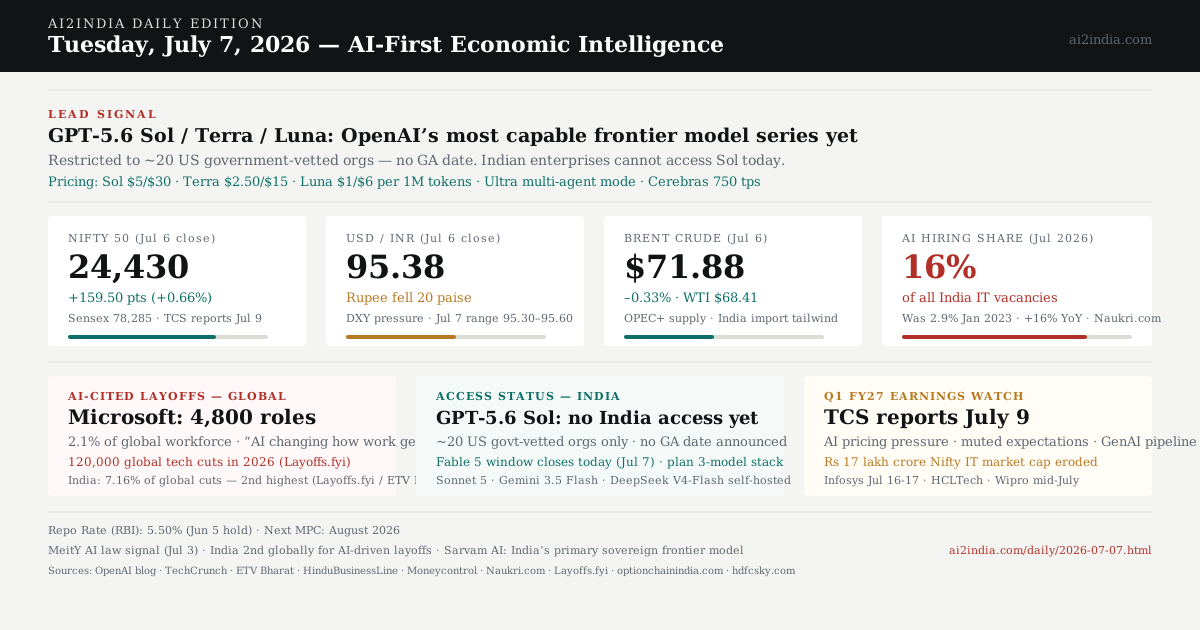
OpenAI’s GPT-5.6 Sol, Terra, and Luna — the most capable frontier model series yet — is in limited preview with only ~20 US government-vetted organisations; no general-availability date has been announced, leaving Indian enterprises locked out of the frontier while Microsoft simultaneously cuts 4,800 roles citing AI and India emerges as the world’s second-highest destination for AI-driven tech layoffs, even as AI hiring surges to 16 per cent of all India IT vacancies.
Tuesday, July 7, 2026: OpenAI previewed its GPT-5.6 series — Sol (flagship), Terra (balanced), and Luna (fast/affordable) — on June 25–26. Access is restricted to approximately 20 government-vetted organisations following a White House request for a staged rollout while national-security cybersecurity reviews are completed. No general-availability date has been announced. Indian enterprises and developers cannot access these models today. Simultaneously, Microsoft announced 4,800 layoffs globally (2.1% of its workforce) on July 6, citing AI as the force reshaping how work gets done — the largest AI-cited single-day cut of 2026, bringing the year’s global AI-cited tech layoffs to 120,000. Against this, fresh data from Naukri.com shows India’s AI-specific hiring surging to 16% of all IT vacancies in July 2026, up from 2.9% in January 2023. India is simultaneously the world’s second-highest country for AI-driven tech layoffs (7.16% of global cuts) and one of the fastest-growing markets for AI talent demand. TCS reports Q1 FY27 results on July 9 — the first Indian IT sector earnings disclosure that will include explicit questions about AI’s revenue impact and headcount trajectory. Today (July 7) is also the last day Fable 5 is accessible on select plans before the access window narrows.
GPT-5.6’s architecture and capabilities represent the clearest signal yet that the frontier model race has entered a new phase. OpenAI’s announcement introduces three distinct tiers within a single model generation: Sol (flagship, maximum reasoning, ultra multi-agent mode), Terra (balanced, GPT-5.5 competitive capability at half the price), and Luna (fast, low-cost, high-throughput). The pricing structure is significant: Sol at $5 input / $30 output per 1M tokens; Terra at $2.50 input / $15 output; Luna at $1 input / $6 output. GPT-5.6 also introduces a 90% discount on cached reads (cache writes billed at 1.25× uncached input rate), making repeated enterprise workflows substantially cheaper than earlier pricing regimes. On Cerebras infrastructure, GPT-5.6 Sol will be available at up to 750 tokens per second — a speed figure that redefines real-time AI agent performance — for select customers beginning July 2026.
The capability claims are material. GPT-5.6 Sol sets a new state of the art on Terminal-Bench 2.1 (command-line workflows requiring planning, iteration, and tool coordination). On GeneBench v1 (genomics and quantitative biology), Sol improves on GPT-5.5 while using fewer output tokens. On ExploitBench, Sol is competitive with Anthropic’s Mythos Preview using only one-third of the output tokens. The Ultra mode goes beyond a single-agent architecture, leveraging coordinated subagents to accelerate complex multi-step workflows — a direct capability advance for enterprise agentic deployments in coding, research synthesis, compliance review, and financial modelling.
The access picture for Indian enterprises is a three-tier structure. The most capable models (GPT-5.6 Sol, Terra, Luna) are in a US government-coordinated preview restricted to ~20 vetted partners; OpenAI “has not announced a general-availability date” (OpenAI Help Center, July 3). The second tier is the existing Fable 5 access window, which closes today (July 7) for the select-plan access that was temporarily available — Indian enterprise teams with Fable 5 access on qualifying plans have today as their final evaluation window. After July 7, the practical architecture for Indian enterprises remains: Sonnet 5 (capable agentic tasks), Gemini 3.5 Flash or DeepSeek V4-Flash API (volume tasks), and DeepSeek V4-Flash self-hosted for regulated-sector data-localisation workloads.
The broader geopolitical context is unavoidable: the US government’s request for staged AI model rollouts — first applied to Fable 5 (Anthropic) in June, now GPT-5.6 Sol (OpenAI) in June-July — is establishing a pattern in which the most capable frontier AI tools are released first in a US government-coordinated manner, with non-US enterprise access delayed. For Indian enterprises, this is not an abstract policy debate. It is a concrete constraint on which AI tools are available for deployment today. Enterprise AI planning teams that set strategy based on frontier capability announcements must now separately track capability announcements versus access availability — GPT-5.6 Sol exists and is the most capable model available, but Indian enterprises cannot use it yet.
Microsoft’s 4,800 role cuts, announced July 6, are particularly significant as a signal because Microsoft is simultaneously OpenAI’s largest investor and a primary delivery channel for OpenAI models to enterprise customers. The cuts are described as affecting roles made redundant by AI automation of everyday tasks. Microsoft says the roles “are not being replaced by AI” but simultaneously acknowledges “AI is changing how work gets done.” This is now a standard formulation for AI-cited layoffs — TechCrunch counts roughly 120,000 global tech roles cut in 2026, with AI as the most-cited reason (Challenger, Gray & Christmas, May 2026 data). For Indian enterprises, the Microsoft cuts are a leading indicator: if the company most deeply invested in enterprise AI deployment is reducing roles at this pace, the AI-driven restructuring signal is not a 2027–2028 scenario. It is happening now.
India’s AI jobs data from ETV Bharat (published July 6) synthesises Naukri.com, Stanford AI Index, and government data into a coherent picture: India accounts for 7.16% of global AI-driven tech layoffs in H1 2026 (second only to the US at 71.33%); AI-specific job vacancies have risen from 2.9% of total in January 2023 to 16% in July 2026; AI talent demand (3.5 lakh professionals in India in 2023, 4.2 lakh in 2024) still runs 50% short of the 6 lakh industry demand figure. India is therefore simultaneously the world’s second-largest destination for AI-driven job cuts and one of the world’s fastest-growing markets for AI talent hiring — a structural paradox that reflects the bifurcation of the Indian IT workforce into an AI-skilled cohort (in demand, premium wages) and an AI-displaced cohort (laid off or not being replaced). The Q1 FY27 earnings season opening Thursday with TCS will begin to put hard revenue numbers on this picture.