Pan-India economic intelligenceDaily Edition — 2026-07-03
AI2

Ai2India

Daily Edition

One daily issue tracking AI adoption, markets, hiring, layoffs, real estate, credit and gig-work signals across India.

PublishedJuly 3Daily issue
Nifty 50 (Jul 2 close)24,175.70+170.85 pts (+0.71%); second straight gain; Sensex 77,502.12 (+580, +0.75%); IT stocks opened firm; Brent below $73 provides broader relief; markets extended recovery above 24,000
USD / INR95.34Jul 2 provisional close; −18 paise; rupee slipped on continued dollar demand despite easing crude; EUR/INR stable; watch 95.50 as near-term level
Brent Crude~$72/bblSlipped below $73 for first time since Feb 27, 2026; ET Jul 2; OPEC+ supply increase and US–Iran diplomacy holding; India import-bill relief strengthening
Repo Rate (RBI)5.50%Jun 5 MPC hold; August MPC is next live window; Warsh Fed hike bias still caps near-term cut room; no new rate signal today

Lead Analysis — AI-First

OpenAI proposes giving the US government a 5% equity stake — $42.6 billion at a $852 billion valuation — in a “Public Wealth Fund” concept that would set a global template for AI governance; China’s Z.ai GLM-5.2 reaches near Claude Opus 4.8 performance at roughly one-eighth the cost, climbing above Anthropic on OpenRouter; and Brent crude slips below $73 per barrel for the first time since February 27, adding to India’s import-cost relief.

Friday, July 3, 2026 opens with the most consequential AI governance story since the Fable 5 export-control episode: the Financial Times reported on July 2 — confirmed by Bloomberg, Reuters, CNBC and The Guardian — that OpenAI has begun preliminary talks to give the US government a 5% equity stake in the company. At OpenAI’s current $852 billion valuation, 5% represents approximately $42.6 billion. The mechanism proposed by CEO Sam Altman is a “Public Wealth Fund,” modelled loosely on Alaska’s Permanent Fund, that would hold and distribute AI-generated equity gains to US citizens. Altman has discussed the concept with President Trump, Commerce Secretary Howard Lutnick and Treasury Secretary Scott Bessent, as well as Democratic Senator Bernie Sanders. The talks are explicitly described as “conceptual” and “preliminary” by all sources, and any formal deal would require an act of Congress to implement. The structural significance is larger than the headline figure: if OpenAI moves forward, it would create a template — and political pressure — for Anthropic, Google DeepMind, xAI and Meta AI to follow. Reuters separately reported on July 2 that the Trump administration and Anthropic have “not discussed” a government stake in that company. For Indian enterprise AI planners, the OpenAI governance story matters for three reasons: it signals the direction of US AI policy (sovereignty, public ownership, geopolitical co-alignment); it accelerates OpenAI’s path toward an IPO (which strengthens its India commercial operations); and it creates a global reference point for AI governance that India’s own government — which just converted its IndiaAI Mission debenture into a 1–2% equity stake in Sarvam AI — is now demonstrably ahead of, not behind, the global curve on. Meanwhile, the AI competitive landscape shifted further: China’s Z.ai (formerly Zhipu AI) has released GLM-5.2, a model that the New York Times reports lands within a percentage point of Claude Opus 4.8 on a key agentic benchmark at approximately one-eighth the cost, while CNBC confirmed it comes within one-fifth the cost on agentic task benchmarks. Former US AI czar David Sacks said this week: “We now have a Chinese open-weight model that is as good as the currently available models from OpenAI and Anthropic.” GLM-5.2 has climbed above Anthropic’s models in OpenRouter usage rankings. Brent crude falling below $73 per barrel for the first time since February 27 provides India a quietly significant macro tailwind that offsets some of the rupee weakness at 95.34. The combined picture for July 3 is: AI governance is entering a new geopolitical phase; Chinese open-source AI is compressing the cost curve faster than US labs anticipated; and India’s macro environment for AI investment is slightly more favourable than it was seven days ago.

The OpenAI “Public Wealth Fund” proposal is the most significant AI governance development of the week — and it has direct structural implications for Indian enterprise AI strategy. The core mechanism, as described by the FT and confirmed by Bloomberg (July 2): OpenAI would voluntarily donate or reserve a 5% equity block to a sovereign-wealth-style fund, which would distribute returns — dividends and eventually IPO proceeds — to US citizens. The notion is explicitly modelled on the Alaska Permanent Fund, which distributes oil wealth to Alaskan residents. Altman’s April 2026 policy document “Distributing the Gains from AI” was the original public framing; the July 2 reports confirm that what was a policy paper has become a structured negotiation with named US government officials. Three structural dimensions matter for Indian enterprise teams. First, it is cash-free to OpenAI: the company does not sell equity to the fund, meaning existing institutional investors (SoftBank, Microsoft, others) are not diluted through a cash transaction — but the equity block does exist and would vest real governance rights in the US government. Second, it sidesteps the AI-tax debate in Congress: rather than legislating a new tax on AI companies — which has stalled repeatedly — a voluntary equity donation achieves the political goal (public participation in AI wealth) without requiring new law for the donation itself, though congressional action may be needed for the fund’s distribution mechanism. Third, and most significant for Indian enterprise: it creates a template that other frontier labs will face pressure to match. If OpenAI’s 5% stake proposal advances, Anthropic — which is also preparing for an IPO at a projected $100+ billion valuation — Google DeepMind, xAI, and Meta AI would each face political and reputational pressure to offer equivalent arrangements. Reuters’s July 2 report that the Trump administration “has not discussed” taking a stake in Anthropic is notable precisely because it is reactive to the OpenAI story: the absence of discussion today does not mean the template will not apply tomorrow.

For Indian enterprise AI planners, the governance story has four specific implications. First, the US government acquiring a formal equity stake in OpenAI would give it formal governance visibility into OpenAI’s strategic decisions — including international partnerships, India-market pricing, and export-control compliance. The Fable 5 episode (June 12–July 1) demonstrated that US government directives can override commercial AI deployment with minimal notice; a formal equity stake would deepen, not reduce, that dynamic. Second, the IPO pathway becomes clearer: Altman’s governance discussions with the Trump administration are part of a broader programme to align OpenAI’s corporate structure with public-company requirements. An OpenAI IPO in 2026 or 2027 would make OpenAI India operations (currently building toward a launch with incoming MD Prabhjeet Singh in September 2026) a formal public-company commitment, not just a strategic priority. Third, the “Public Wealth Fund” concept has an unexpected resonance with India’s own AI governance approach: India’s IndiaAI Mission just converted a ₹98.68 crore debenture into a 1–2% equity stake in Sarvam AI — making India’s government a co-owner of a domestic frontier AI company before the US government has formalised any ownership in OpenAI. India is not behind the curve on sovereign AI ownership; it is, arguably, slightly ahead of it. Fourth, for Indian public-sector procurement teams evaluating AI vendors: the US government’s potential ownership stake in OpenAI adds a new “government-aligned” dimension to OpenAI’s vendor profile — one that may strengthen or complicate procurement decisions depending on the procuring ministry’s data sovereignty framework.

China’s Z.ai GLM-5.2 is the second most important AI story of the week for Indian enterprise teams, and it is not yet receiving proportionate coverage in Indian business media relative to its significance. The model, developed by Beijing-based Z.ai (formerly Zhipu AI), was reported by the New York Times (June 25) and confirmed by CNBC (June 26), Moneycontrol, and NDTV. Key validated data points: GLM-5.2 lands “within a percentage point of Anthropic’s Claude Opus 4.8 on a key agentic benchmark” (NYT) at approximately one-eighth the cost on certain tasks; it scores “within a fifth of the cost” on agentic task benchmarks more broadly (CNBC); and it has climbed above Anthropic’s models on OpenRouter’s usage ranking — a direct signal of developer adoption. Former US AI czar David Sacks stated that GLM-5.2 is “as good as the currently available models from OpenAI and Anthropic,” before the US lifted export controls on Fable 5 and Mythos 5. The “currently available” qualifier matters: GLM-5.2 is competitive with Opus 4.8 and Sonnet 5, not with the unreleased Fable 5 or GPT-5.6. But the cost curve is the structural story: Z.ai has replicated the DeepSeek pattern — achieving near-frontier capability at dramatically lower inference cost. For Indian enterprises, the Z.ai GLM-5.2 story creates a new option that was not on the planning board two weeks ago: a near-frontier open-weight model that can be self-hosted (removing the US export-control dependency risk demonstrated by the Fable 5 suspension) at dramatically lower cost per API call than US alternatives. The caveat is real and important: GLM-5.2 is developed by a Beijing-based company under Chinese data law. For Indian regulated sectors — BFSI, healthcare, government — deploying a self-hosted version of GLM-5.2 would require a careful data-residency and supply-chain assessment that is not straightforward. For Indian AI startups building inference-cost-sensitive products (not involving regulated data): GLM-5.2’s cost profile is a legitimate evaluation candidate alongside Sonnet 5 ($2/M intro) and Gemini 3.5 Flash ($1.50/M).
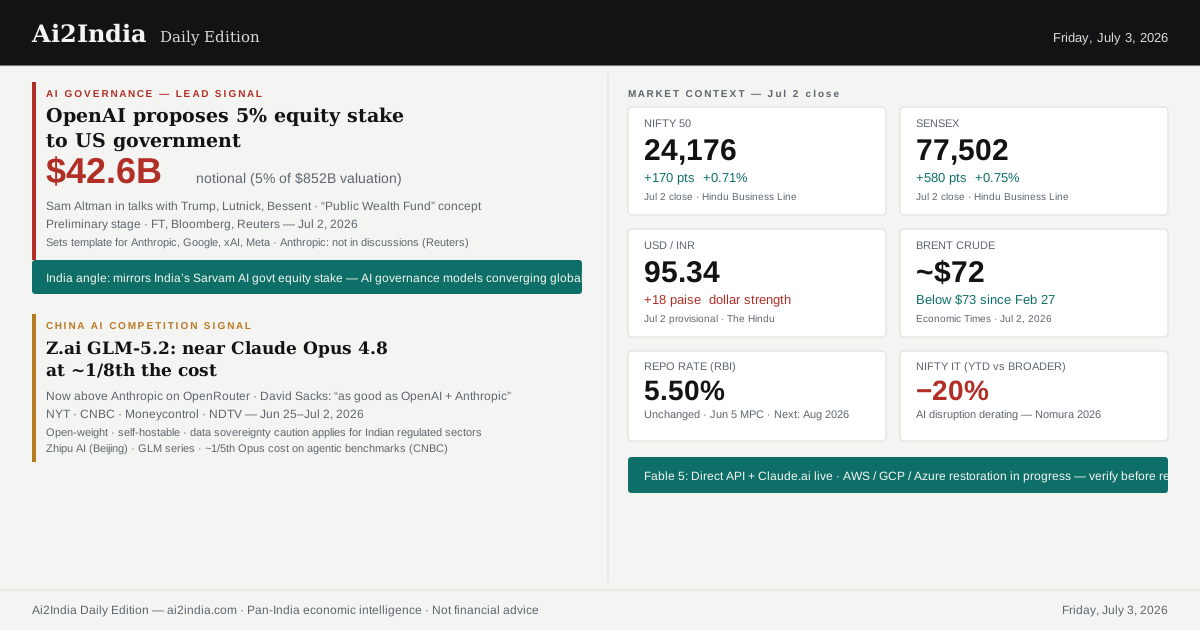
July 3 signal board: OpenAI proposes 5% US govt equity stake — $42.6B notional; Z.ai GLM-5.2 near Claude Opus 4.8 at 1/8 cost; Nifty 24,176 (+0.71%); Sensex 77,502 (+0.75%); USD/INR 95.34; Brent ~$72 (below $73 first time since Feb 27); Repo 5.50%
Today’s economic signal board. Full analysis in the Daily Edition.

AI Developments Today

Friday, July 3: four developments that pass the “Would this change what an Indian enterprise AI planner does this week?” filter. The OpenAI US government stake proposal changes how Indian procurement teams must assess OpenAI’s governance profile; China’s Z.ai GLM-5.2 opens a new cost-competitive AI option with caveats; Fable 5 cloud-platform restoration status moves to “verify before restoring production” mode; and the Gemini 3.5 Pro delay persists with no new GA date.

DevelopmentSource + DateIndia RelevanceWhat this means for Indian enterpriseStatus
OpenAI in early talks to give US government a 5% equity stake — ~$42.6 billion at $852 billion valuation — via a “Public Wealth Fund” modelled on the Alaska Permanent Fund; Sam Altman in discussions with Trump, Lutnick, Bessent and Bernie Sanders; talks “conceptual and preliminary”; would require act of Congress; Anthropic not in discussions (Reuters)

The Financial Times reported late on July 2, 2026 (US Eastern time), confirmed by Bloomberg, Reuters, CNBC and The Guardian, that OpenAI CEO Sam Altman has begun preliminary discussions about voluntarily handing the US government a 5% equity stake in the company as part of a broader “Public Wealth Fund” concept. The mechanism: OpenAI would place a 5% equity block into a sovereign-wealth-style investment vehicle — not a direct sale, but a reservation or donation of equity — which would then distribute returns (dividends, and eventually IPO proceeds) to US citizens. At OpenAI’s current $852 billion private-market valuation, 5% equals approximately $42.6 billion. The concept was first outlined in Altman’s April 2026 OpenAI policy document “Distributing the Gains from AI.” Altman has discussed the proposal directly with President Trump, Commerce Secretary Howard Lutnick, and Treasury Secretary Scott Bessent. He has also reportedly spoken with Democratic Senator Bernie Sanders, who had separately proposed a sovereign wealth fund financed by a one-time 50% tax on AI company stock (Guardian, June 2026). The July 2 reports confirm the talks have moved from a policy document to a structured negotiation. Key caveats: the talks are described as “conceptual” and “early-stage” by all sources; no deal has been signed; formal implementation would require an act of Congress. Reuters separately reported on July 2 that “the Trump administration and Anthropic have not discussed the government taking a stake” in Anthropic. The mechanism is cash-free to OpenAI: the company does not sell equity to the fund in exchange for cash — it issues (or reserves) equity, meaning the immediate cash impact on OpenAI’s balance sheet is zero. This sidesteps the AI-tax debate while achieving the political goal of public participation in AI wealth generation. It also creates a template: if OpenAI formalises this arrangement, Anthropic, Google DeepMind, xAI, and Meta AI would face equivalent political and reputational pressure to offer similar stakes.
FT (Jul 2, 2026); Bloomberg (Jul 2, 2026); Reuters (Jul 2, 2026); CNBC (Jul 2, 2026); Guardian (Jul 2, 2026); Andrew.ooo analysis (Jul 2, 2026); Forbes (Jul 2, 2026) This is the most significant AI governance development of July 2026 for Indian enterprise teams for four structural reasons. First, it signals the direction of US AI policy: sovereignty, public co-ownership, and geopolitical alignment with AI companies — the same instinct that drove the Fable 5 export-control suspension is now being expressed as a positive ownership arrangement. Indian enterprises planning multi-year commitments to US AI providers need to factor in a US government that is becoming an equity stakeholder in those providers. Second, OpenAI’s accelerating IPO timeline (implied by governance alignment talks with the Trump administration) strengthens the commercial permanence of OpenAI India operations — Prabhjeet Singh’s September 2026 arrival as India MD becomes a more durable commitment in an IPO-track company than in a private one. Third, India’s own Sarvam AI government equity model is now explicitly validated as a global governance pattern: India’s IndiaAI Mission acquired a 1–2% stake in Sarvam AI before the US government has formalised any equivalent in OpenAI. India’s sovereign AI approach is ahead of, not behind, the global curve. Fourth, for Indian public-sector AI procurement teams: a US government equity stake in OpenAI strengthens the “sovereign-aligned” credential of OpenAI products — but also raises questions about data governance when the AI provider’s largest stakeholder is a foreign government. Immediate action for Indian enterprise teams: (1) Flag the OpenAI governance development in Q3 AI vendor risk reviews — the governance profile of OpenAI has changed materially in 30 days. (2) For Indian public-sector procurement teams: begin a formal assessment of whether a US-government-equity-stakeholder AI provider is compliant with your data sovereignty framework. (3) For GCCs reporting to US parent companies: note that US parent AI strategies may increasingly integrate OpenAI as a government-aligned sovereign choice — factor this into your India GCC AI stack alignment plan. (4) No immediate operational action required: the talks are preliminary and no deal is signed. Maintain multi-provider AI architecture. Verified global — FT; Bloomberg; Reuters; Jul 2
China’s Z.ai (Zhipu AI) releases GLM-5.2 — near Claude Opus 4.8 performance on agentic benchmarks at approximately one-eighth the cost; climbs above Anthropic on OpenRouter usage rankings; open-weight and self-hostable

Z.ai (formerly Zhipu AI), a Beijing-based AI startup, has released GLM-5.2, the latest in its GLM (General Language Model) series. The New York Times reported on June 25, 2026 that GLM-5.2 “costs about an eighth as much as Anthropic’s Claude Opus 4.8” on certain tasks while landing “within a percentage point” of Opus 4.8 on a key agentic benchmark. CNBC (June 26) reported it scores within one-fifth of the Opus 4.8 cost on broader agentic task benchmarks, and Snowflake CEO Sridhar Ramaswamy and venture capitalist Marc Andreessen both praised its capabilities. GLM-5.2 has climbed above Anthropic’s models in OpenRouter usage rankings — a real-world developer signal of adoption momentum. Former US AI czar David Sacks stated: “We now have a Chinese open-weight model that is as good as the currently available models from OpenAI and Anthropic.” The “currently available” qualifier is important: the comparison is to Opus 4.8 and Sonnet 5, not to the unreleased Fable 5 or GPT-5.6. The “open-weight” designation means the model weights can be downloaded and run on local or private cloud infrastructure — no API dependency on a US provider, no US export-control vulnerability. Microsoft has reportedly considered adding the latest DeepSeek model (a related Chinese open-source AI) to power one of its products (NYT, citing two unnamed sources). The pattern Z.ai represents is structurally identical to the one DeepSeek established 18 months earlier: achieve near-frontier performance at a fraction of the inference cost by optimising training efficiency, then open-weight it to maximise adoption and pressure US labs on pricing. NDTV covered the India angle explicitly: “China’s Z.AI Is Here: Should India Worry About The Next AI Power Shift?”
NYT (Jun 25, 2026); CNBC (Jun 26, 2026); Moneycontrol (Jul 2, 2026); Telegraph India (Jul 2, 2026); NDTV (Jul 2, 2026); wtaq.com analysis (Jul 2, 2026) The Z.ai GLM-5.2 story has three distinct India relevance dimensions. First, cost: at ~1/8th to 1/5th the inference cost of Claude Opus 4.8, GLM-5.2 compresses the cost curve for near-frontier agentic AI capabilities. For Indian AI startups and enterprises building inference-cost-sensitive products — document processing, agentic workflows, chatbots — this cost profile is a real evaluation candidate. Second, sovereignty: the open-weight, self-hostable architecture removes the US-provider dependency that the Fable 5 suspension demonstrated is a real continuity risk. An Indian enterprise or startup running GLM-5.2 on Indian cloud or on-premise infrastructure has no dependency on US government export control decisions. Third, risk: GLM-5.2 is developed by a Beijing-based company under Chinese data law. Self-hosting the weights does not eliminate supply-chain or provenance risk — the model was trained on data under Chinese regulatory framework, and the model weights themselves could in principle contain embedded behaviours not visible in benchmarks. For Indian regulated sectors (BFSI, healthcare, government), this requires a specific due-diligence assessment that is not currently standardised in India. For Indian AI startups building on non-regulated data: the risk calculus is different and GLM-5.2 is a legitimate cost-competitive option. For cost-sensitive AI startups and non-regulated enterprise use cases: evaluate GLM-5.2 as a third cost tier alongside Sonnet 5 ($2/M) and Gemini 3.5 Flash ($1.50/M). For regulated sectors (BFSI, health, government): do not deploy without a formal supply-chain and provenance assessment. For all teams: use the Z.ai story as the prompt for a formal “open-weight Chinese model” risk-and-opportunity policy — it will not be the last such development. Do not conflate open-weight (self-hostable weights) with open-source (verifiable training data and code) — GLM-5.2 is the former, not necessarily the latter. Verified global — NYT; CNBC; Moneycontrol; NDTV; Jun 25–Jul 2
Fable 5 cloud-platform restoration update — AWS Bedrock, Google Cloud Vertex AI, Microsoft Azure Foundry: Anthropic confirmed “in progress” as of July 1; no new completion confirmation as of July 3 morning (IST)

Carry-forward with July 3 status note. Anthropic’s June 30 blog post confirmed Fable 5 and Mythos 5 are globally restored on: Claude.ai (all plan tiers), Claude Code, and Claude Cowork. For the three major cloud platforms — AWS Bedrock, Google Cloud Vertex AI, and Microsoft Azure Foundry — Anthropic stated it will “re-enable access as quickly as possible.” As of July 3, 7:00 AM IST, no new official Anthropic announcement has been made confirming cloud platform restoration is complete. Indian enterprises whose production Fable 5 workloads run through these cloud providers should verify platform-specific status with their AWS/GCP/Azure account teams before restoring Fable 5 to production pipelines. Enterprise plan caveats remain in effect: standard Enterprise seats require usage credits for Fable 5 access; Premium Enterprise seats have 50% weekly usage included through July 7, after which credits are required. For teams using direct Anthropic API and Claude.ai: access has been live since July 1. No new Fable 5-related incidents or access disruptions have been reported since the July 1 restoration.
Anthropic blog “Redeploying Fable 5” (Jun 30, 2026); Business Standard (Jul 1); carry-forward The cloud-platform restoration remains the primary operational uncertainty for Indian enterprises in the Fable 5 story. India has a high concentration of GCC and IT services firms running AI workloads on AWS and Google Cloud — the “in progress” status for these platforms means a meaningful share of India’s enterprise Fable 5 capacity is not yet confirmed available. The lack of a new completion announcement 48 hours after the July 1 restoration is not alarming (cloud provider integration at enterprise scale takes time), but it means Indian enterprise teams should not assume Fable 5 is available on their cloud infrastructure without verification. Verify cloud platform status before restoring Fable 5 to AWS/GCP/Azure production pipelines. Direct API and Claude.ai users: fully available. Keep multi-provider architecture as permanent policy — the geopolitical AI access risk is now a documented enterprise continuity variable. Carry-forward — cloud restoration in progress; no new completion confirmed (Jul 3)
Gemini 3.5 Pro — no new GA announcement as of July 3; still in limited Vertex AI enterprise preview; Gemini 3.5 Flash remains the available Google frontier model; Google DeepMind talent exodus carry-forward

No new Gemini 3.5 Pro developments since the July 2 edition. The model remains in limited Vertex AI enterprise preview with no confirmed general availability date as of July 3, 7:00 AM IST. The July 2 edition documented in detail: Gemini 3.5 Pro was promised for June 2026 at Google I/O (May 19), was delayed to “July” citing quality refinements, and has not received a formal GA announcement. Gemini 3.5 Flash ($1.50/M input; $9/M output; 1,048,576-token context) remains the recommended upgrade path from Gemini 2.5 Flash for Google Cloud-committed teams. The Google DeepMind talent exodus — John Jumper (AlphaFold Nobel) and Noam Shazeer (Transformer co-inventor) plus Jonas Adler and Alexander Pritzel to Anthropic and OpenAI — carries forward as a negative leading indicator for Gemini model velocity, with no new developments today.
Carry-forward from Jul 2 edition (TechTimes; Google Cloud; OpenRouter; Bloomberg; Jun 28–Jul 2) No change in Gemini 3.5 Pro access constraints. For Google Cloud-committed teams: Gemini 3.5 Flash is the current recommended frontier option; do not delay Q3 AI model decisions waiting for Pro GA. The Z.ai GLM-5.2 story adds a new dimension to the Google competitive evaluation: Indian teams on Google Cloud now have three frontier alternatives to evaluate (Fable 5 restored, Sonnet 5 new, Gemini 3.5 Flash) plus a cost-tier option (GLM-5.2, with sovereignty caveats). The talent exodus carry-forward remains a Q3 planning variable, not a current capability impairment. Carry-forward — no new developments (Jul 3)

India AI Ecosystem

Friday, July 3: the OpenAI governance story contextualises India’s sovereign AI position unexpectedly favourably — India’s government acquired equity in Sarvam AI before the US government has formalised any equivalent in OpenAI. The India AI talent gap story and the Forbes analysis of India’s IT services positioning provide structural context for where Indian enterprise AI development stands at the start of July.

Platform / OrganisationDevelopmentIndia AI SignificanceStatus
Sarvam AI — IndiaAI Mission equity stake
$300M Series B
~$1.5B valuation
Govt: 1–2% equity (CCD conversion)
Sovereign AI validation
Carry-forward from July 1–2, with new contextual frame. The India government’s IndiaAI Mission has converted its ₹98.68 crore compulsorily convertible debenture into a 1–2% equity stake in Sarvam AI as the company’s $300 million Series B closes at approximately $1.5 billion valuation. Current metrics: 10 million API calls per day; thevam30B (edge) and thevam105B (large) models; ICAI MoU covering 4 million chartered accountants; no US export-control dependency. The OpenAI “Public Wealth Fund” proposal (July 2) now frames the Sarvam equity stake in a new light: India acquired government equity in a frontier AI company before the US government has done so. India’s model — direct equity in a domestic AI startup funded by government mission capital — is not a deviation from global norms; it is a preview of a governance pattern that the world’s largest AI market is now beginning to adopt. The Sarvam AI government equity stake is now both a domestic sovereign AI signal and a global AI governance benchmark. For Indian enterprise AI procurement teams that evaluate vendor credibility partly on government institutional backing: Sarvam has the strongest such credential in India’s domestic AI market. For Indian regulated-sector CIOs comparing Sarvam to US providers: the OpenAI governance talks make the “data sovereignty / government equity” axis a live comparison point, not a theoretical one. Sarvam has no US export-control dependency — the Fable 5 episode confirmed this is a material procurement variable. Verified India — ET; Medianama; Jun 25–26 (carry-forward)
India AI talent gap
NASSCOM + McKinsey projection
1.4M professional shortfall by 2026
Times of India coverage
Times of India (July 1, 2026) reports a NASSCOM and McKinsey joint projection that India’s AI professional talent gap “would exceed 1.4 million AI professionals if the pace of upskilling was not dramatically accelerated.” The projection covers the gap between AI-capable talent supply and enterprise demand across IT services, BFSI, manufacturing, and GCC sectors. This figure is contextualised by the existing signals in this publication: NASSCOM data shows 3.5 lakh AI/ML openings in the most recent 90-day window (accelerating demand) while software development postings have fallen 12.3% (contracting traditional supply). The talent gap is the structural bridge between the two: India has an AI demand surge and a traditional-IT supply contraction occurring simultaneously, with insufficient speed of reskilling to connect them. The 1.4 million AI professional shortfall is the most cited India-specific AI workforce figure in institutional research for mid-2026. For enterprise AI teams: the gap is a hiring-market signal (AI/ML salaries will continue to command premiums); a reskilling imperative (internal upskilling is faster than external hiring for most large Indian enterprises); and a policy anchor (government skilling programmes should be evaluated against this gap, not just against NASSCOM’s 25M digital-worker target). The Z.ai cost-compression story adds urgency: as frontier AI capabilities become cheaper, the premium shifts from “who can afford the model” to “who has the talent to build with it.” Verified signal — NASSCOM + McKinsey; Times of India; Jul 1, 2026
Forbes analysis — India IT services positioning on AI
“India Missed The First AI Value Layer. It Has Not Missed AI”
Forbes Tech Council (Jul 2)
Forbes Tech Council published on July 2, 2026: “India Missed The First AI Value Layer. It Has Not Missed AI.” The analysis argues that Infosys, TCS, and Wipro did not build foundation models — but neither did Accenture, Cognizant, or Capgemini. The comparison deframes the India IT services AI critique: the question is not whether India’s IT companies built GPT or Gemini, but whether they are positioned to build AI-enabled services on top of foundation models. The analysis positions India’s IT services firms as competitive in AI integration and deployment (the application layer) even if they missed the foundation model layer. Context for readers of this publication: Nifty IT is still −20% vs broader market (Nomura) despite this more nuanced framing — the market has discounted the optimistic positioning, at least so far in 2026. The Forbes framing is relevant for Indian IT services firms constructing their AI narrative for investors and clients. The “application layer” positioning is Infosys Topaz, TCS AI Cloud, and Wipro AI360’s actual market stance — the Forbes article provides a mainstream narrative anchor for that positioning. For enterprise AI planners evaluating Indian IT services partners: the key evaluation question is not “do they have a foundation model?” but “can they deploy and integrate AI effectively in my sector?” The Nifty IT −20% derating suggests the equity market is not yet convinced by the application-layer argument alone. Verified signal — Forbes Tech Council; Jul 2, 2026
Carry-forward: ICAI + Sarvam MoU; Neysa AI $1.5B; OpenAI India MD; NASSCOM AI data; Maharashtra AI Policy; IndiaAI Mission 45K GPUs All carry-forward items unchanged. ICAI + Sarvam AI MoU (Jun 26; 4M members; AICA Level 3 curriculum; custom accounting LLM planned). Neysa AI $234M Series B at $1.5B (HCLTech-led $150M; Jun 15) — second Indian AI unicorn at $1.5B. OpenAI India MD: Prabhjeet Singh (ex-Uber India President) arriving September 2026. NASSCOM (Jun 26): 25% India IT in production AI; $10–12B AI services revenue forecast; 2M+ skilled. Maharashtra AI Policy 2026: ₹10,000 crore target; ₹500 crore VC fund; 12 incubators. IndiaAI Mission: 45,000+ GPUs deployed nationally (confirmed Jul 1). Z.ai GLM-5.2 adds a new open-weight dimension to this ecosystem: cheap, near-frontier AI capability is now available without a US provider, which changes the economics of building on India’s national GPU infrastructure. The Z.ai development adds new relevance to India’s 45,000-GPU national compute baseline: this infrastructure is now potentially optimised for running open-weight models like GLM-5.2 (with appropriate sovereignty assessment), in addition to training domestic models like Sarvam’s thevam family. The NASSCOM “25% in production AI” figure should be revisited in Q3 2026 as Fable 5 restoration and Z.ai availability expand the frontier option set available to Indian enterprises. Verified India — Multiple; Jun 15–Jul 2 (carry-forward)

AI Adoption Impact

July 3: the three structural AI adoption signals for India are unchanged (frontier access restored, IT sector under structural AI pressure, AI/ML roles in high demand). Two new dynamics add complexity: the Z.ai cost compression story expands the frontier AI option set for cost-sensitive use cases; the OpenAI governance story introduces a new dimension of US government co-ownership in AI providers that Indian enterprises use.

AI Impact DimensionEvidenceTrajectory
Frontier AI cost curve: Z.ai GLM-5.2 adds a fourth cost tier alongside Fable 5, Sonnet 5, Gemini 3.5 Flash — near-frontier capability at sub-$0.20/M input (estimated) NYT; CNBC; Moneycontrol; NDTV (Jun 25–Jul 2). GLM-5.2 at ~1/8 Claude Opus 4.8 cost on certain tasks. OpenRouter shows it above Anthropic models in usage rankings. Open-weight architecture means marginal inference cost is infrastructure cost only (no per-token API charge) for self-hosted deployments. The DeepSeek pattern repeating: Chinese lab achieves near-frontier at dramatically lower cost, then open-weights it. Implication for India: the floor on near-frontier AI inference cost has just dropped significantly for teams willing to self-host and accept the Chinese provenance caveat. ↓ Cost floor falling fast; ↑ procurement complexity rising; frontier AI pricing will compress further through 2026
AI governance risk dimension: US government moving toward equity co-ownership of frontier AI providers — adds geopolitical layer to vendor risk assessments FT; Bloomberg; Reuters (Jul 2). OpenAI’s proposed 5% US govt stake adds a formal government ownership dimension to the world’s most widely used AI platform. The Fable 5 export-control episode (June 12–July 1) demonstrated government directive power over AI access; equity co-ownership would add governance visibility on top. For Indian regulated-sector buyers: this changes the risk profile of US AI providers in a way that makes domestic and non-US alternatives more strategically attractive over a 3–5 year horizon. For Indian GCCs reporting to US parent companies: the “government-aligned” credential of US AI providers may become a positive procurement signal rather than a negative one, depending on the geopolitical frame of the US parent organisation. ↑ Geopolitical complexity rising; governance due diligence on AI vendors will become a standard enterprise procurement step in India by end-2026
India IT structural signals: Nifty IT −20% YTD; software dev postings −12.3%; AI/ML demand accelerating; 1.4M talent gap (carry-forward) Nomura (Moneycontrol; Jul 2026); NASSCOM; McKinsey; Times of India (Jul 1); Business Standard (Jun 30). Nifty IT underperformed by 20% vs broader market YTD on AI disruption valuation compression. Software dev postings −12.3% in 3 months. AI/ML/data roles: 3.5 lakh openings in 90 days. NASSCOM + McKinsey: 1.4 million AI professional talent gap by 2026 if upskilling pace not accelerated. These structural signals are unchanged by today’s model news and form the employment-economy baseline for the July 3 edition. Oracle FY2026 10-K: AI cited for 21,000 global job cuts (carry-forward). ↓/↑ Structural divergence continues; AI premium roles accelerating; traditional IT contracting; no near-term reversal signal
India import-cost improvement: Brent below $73/bbl for first time since Feb 27 — positive macro backdrop for AI investment Economic Times (Jul 2); TradingEconomics; poundf.co.uk. Brent peaked at $120.88 on April 30, 2026. As of July 2, it has fallen below $73 — a $48/bbl decline in two months. India imports approximately 85% of its crude oil; the fall from $120 to $72 represents a substantial improvement in the current account deficit. Lower crude also reduces inflationary pressure and gives the RBI more room to consider rate cuts at the August MPC meeting. For Indian AI investment: lower crude → lower inflation → more room for rate cuts → lower cost of capital for AI infrastructure investment. The indirect effect is real even if not immediate. ↑ Positive macro tailwind for India AI investment; crude decline adds structural support that markets (+0.71% on Jul 2) are beginning to reflect

Five Things That Changed

Friday, July 3: two global AI governance/competition developments (OpenAI US govt stake; China Z.ai GLM-5.2 cost breakthrough), one commodity tailwind (Brent below $73), one AI access carry-forward (Fable 5 cloud platforms), and market context (Nifty 24,176 second session above 24,000).

SignalData PointReader ImpactStatus
OpenAI proposes 5% equity stake to US government — $42.6B “Public Wealth Fund”; Altman in talks with Trump, Lutnick, Bessent; Anthropic not in discussions (Reuters) FT; Bloomberg; Reuters; CNBC; Guardian (Jul 2, 2026). 5% of $852B = $42.6B notional. Voluntary equity donation to sovereign-wealth-style fund. Modelled on Alaska Permanent Fund. “Conceptual and preliminary.” Would require act of Congress. Sets template for Anthropic, Google, xAI, Meta. Anthropic: Trump admin “has not discussed” stake (Reuters). OpenAI April 2026 policy doc “Distributing the Gains from AI” is the origin. Cash-free to OpenAI — equity reservation/donation, not cash sale. Sidesteps AI-tax debate while achieving public-participation-in-AI-wealth goal. Add OpenAI governance structure change to Q3 2026 AI vendor risk reviews. For Indian public-sector procurement: assess data sovereignty implications of a US-government-equity-stakeholder AI provider. For GCCs: note that US parents may increasingly view OpenAI as a “government-aligned” choice. No immediate operational action required. Verified global — FT; Bloomberg; Reuters; Jul 2
China Z.ai GLM-5.2 near Claude Opus 4.8 at ~1/8 cost · above Anthropic on OpenRouter · open-weight, self-hostable NYT (Jun 25); CNBC (Jun 26); Moneycontrol; NDTV; Telegraph India (Jul 2). Within 1% of Opus 4.8 on agentic benchmark at ~1/8 cost (NYT). Within 1/5 cost on agentic tasks (CNBC). Above Anthropic on OpenRouter rankings. David Sacks: “as good as currently available OpenAI + Anthropic models.” Open-weight — self-hostable. Developed by Zhipu AI (Beijing). No US export-control dependency for self-hosted deployments. Microsoft reportedly considering DeepSeek for products (NYT). Z.ai repeating the DeepSeek pattern: near-frontier at dramatically lower cost then open-sourcing for adoption. For non-regulated AI startups and cost-sensitive enterprise use cases: evaluate GLM-5.2 as a new cost tier. For regulated sectors: formal due diligence required before deployment. For all teams: create a formal policy on open-weight Chinese AI models — this development will recur. Do not conflate open-weight (self-hostable weights) with open-source (verifiable training data). Verified global — NYT; CNBC; Moneycontrol; NDTV; Jun 25–Jul 2
Brent crude below $73/bbl for first time since February 27, 2026 — India import-bill relief accelerating Economic Times (Jul 2); TradingEconomics (WTI $68.43 Jul 3); poundf.co.uk (Brent ~$71.57 previous close). Brent peaked $120.88 Apr 30. Now ~$72 — $48/bbl decline in two months. OPEC+ supply increase + US–Iran diplomacy holding + slowing global demand. India imports ~85% crude. Falls directly reduce CAD pressure and imported inflation. Times of India (Jul 2): paint companies raised prices 14–16% March–June on crude costs — easing crude may now reverse those. Downstream: easing inflation → more room for RBI rate cut at August MPC. Macro tailwind for Indian enterprises: lower oil cost → lower inflation → lower cost of capital over time. For AI infrastructure investment decisions: the improving macro environment strengthens the case for committing to H2 2026 AI investment rather than deferring. No immediate action, but include in H2 budget planning assumptions. Verified — Economic Times; TradingEconomics; Jul 2–3
Fable 5: AWS / GCP / Azure cloud-platform restoration still “in progress” — 48 hours post-July 1 lift; no completion confirmation as of July 3 Anthropic blog (Jun 30); Business Standard (Jul 1); no new confirmation Jul 2–3. Direct API + Claude.ai + Code + Cowork: fully live since Jul 1. Cloud platforms (AWS/GCP/Azure): Anthropic “re-enabling as quickly as possible” — no confirmed completion. Enterprise plan caveats: standard Enterprise requires credits; Premium Enterprise 50% through Jul 7 then credits. India = Anthropic’s 2nd-largest market (Rediff). No new access-barrier events reported. Multi-provider architecture (using Sonnet 5 and Gemini 3.5 Flash during suspension) is still the recommended permanent practice. Indian enterprises on AWS/GCP/Azure: verify Fable 5 availability with your cloud provider before restoring production workloads. Do not assume restoration because 48 hours have passed. For direct API users: fully available. Maintain multi-provider architecture as permanent risk management. Carry-forward — cloud restoration in progress (Jul 3)
Markets: Nifty 24,176 (Jul 2 +0.71%); Sensex 77,502 (+0.75%); USD/INR 95.34 (−18 paise); Brent ~$72/bbl; Repo 5.50% Hindu Business Line; Times of India; The Hindu; ET (Jul 2). Nifty +170 pts second gain above 24,000; Sensex +580 pts. Rupee −18 paise at 95.34 on sustained dollar demand; rupee gave back some recovery despite crude relief. Brent below $73 for first time since Feb 27. Repo unchanged. IT stocks opened firm Jul 2 (India TV News) but Nifty IT still structurally −20% YTD (Nomura). VIX declining (ICICI Direct pattern from prior session). Watch 24,250 as Nifty resistance; watch 95.50 INR level. Market context only. Nifty consecutive gains above 24,000 are a technical recovery signal — not a reversal of the structural Nifty IT derating. Crude below $73 is the macroeconomically more significant development. USD/INR at 95.34 remains on the weaker side — no immediate relief expected without a shift in dollar strength. Verified — Hindu Business Line; The Hindu; ET; Jul 2

Data Variables Ledger

Verified numbers as of Friday, July 3, 2026. Market data as of July 2 close (most recent trading day; India markets open July 3 but data not yet available at 7:00 AM IST). Carry-forward where same-day data not yet available.

VariableCurrent ValuePriorSource + DateNote
Nifty 5024,175.7024,005.85 (Jul 1)Hindu Business Line; Investing.com; Jul 2, 2026+170.85 (+0.71%); second consecutive gain; back above 24,000 for second session
Sensex77,502.1276,922.64 (Jul 1)Hindu Business Line; Times of India; Jul 2, 2026+579.48 (+0.75%); IT stocks opened firm; extended post-expiry recovery
USD / INR95.3495.23 (Jul 1)The Hindu; Jul 2, 2026 (provisional)−18 paise; rupee weakened on dollar demand despite crude relief; provisional close
Brent Crude~$72 / bbl~$73 (Jul 1)Economic Times; TradingEconomics; poundf.co.uk; Jul 2–3, 2026Below $73 for first time since Feb 27, 2026; down from $120.88 peak (Apr 30); India import-bill relief accelerating
Repo Rate5.50%5.50%RBI MPC Jun 5, 2026Unchanged; next MPC window August 2026; crude fall adds room for August cut consideration
Nifty IT (YTD underperformance)−20% vs broader mkt−20% (Jul 2)Nomura; Moneycontrol; Jul 2026Unchanged; AI disruption valuation compression; IT stocks firm in opening session Jul 2 but structural derating persists
OpenAI valuation~$852B~$852BFT; Bloomberg; CNBC; Jul 2, 2026Basis for 5% govt stake calculation = $42.6B notional; no new funding round; preliminary-talks context only
Anthropic Fable 5 accessLive (direct API + Claude.ai); AWS/GCP/Azure pendingSuspended Jun 12–Jun 30Anthropic blog (Jun 30); Jul 3 statusCloud platform restoration in progress; no new completion confirmation; enterprise credit caveats in effect
Anthropic Sonnet 5 pricing (intro)$2/M input · $10/M outputN/A (new Jun 30)Anthropic; TechCrunch; Jun 30, 2026Intro rate through Aug 31; standard $3/$15 from Sep 1
Google Gemini 3.5 Flash pricing$1.50/M input · $9/M outputGemini 2.5 Flash: $0.30/M inputOpenRouter; Google Cloud; Jun 30, 20261,048,576 token context; no change in pricing or status from Jul 2
China Z.ai GLM-5.2 (estimated)~1/8 Claude Opus 4.8 cost (certain tasks)N/A (new release Jul 2026)NYT (Jun 25); CNBC (Jun 26)Open-weight; self-hostable; agentic benchmark near Opus 4.8; data sovereignty caveat for Indian regulated sectors
GPT-5.6 Terra pricing (preview)~50% GPT-5.5 priceN/A (new; limited preview)Reuters; ET; Jun 26–27 (carry-forward)Still limited preview; public rollout delayed; no change
Sarvam AI valuation~$1.5B~$1.0B (prior round)ET; Medianama; Jun 25–26$300M Series B; 1–2% India govt equity; 10M API calls/day; no US export-control dependency
India AI/ML openings (90-day)3.5 lakhCarry-forwardNASSCOM; LinkedIn; carry-forwardNASSCOM + McKinsey project 1.4M AI talent gap by 2026 if upskilling pace not accelerated (TOI Jul 1)
India national GPU count45,000+ deployed~38,000 (estimated)MeitY / ANI; Jul 1, 2026 (confirmed)IndiaAI Mission compute backbone; Z.ai open-weight deployment is now a potential use case for this infrastructure

Verified Layoff Radar

India-confirmed items only. AI-driven restructuring flagged separately. No new India-verified entries today — most recent corporate watchlist sweep (Jun 1) showed no promotable new India-confirmed items. Existing verified items unchanged. No July 3 sweep file available; using most recent sweep baseline.

CompanySectorAnnouncedIndia ImpactAI-Driven?StatusSource
Oracle Enterprise Software FY2026 annual report (confirmed) 21,000 global; India ~12,000 est. (Mint; not company-confirmed) Yes — FY2026 10-K explicitly cites AI for restructuring Verified global; India est. — Mint Bloomberg; Mint; Jun 22, 2026
Opendoor PropTech Jun 2026 ~250 India (verified) No — business restructuring Verified India ET; Moneycontrol; Jun 2026
TCS IT Services FY2026 Headcount down 23,460 (company-reported; not framed as layoffs) Partial — AI-led workforce reset; Wings assessment freeze Verified workforce change — company data TCS Q4 FY26 results; Moneycontrol; May 2026
HCLTech IT Services Jun 2026 170–200 Noida (source-based; company declined comment) Partial — Xerox BPM contract ramp-down Watchlist — source only; no company disclosure Moneycontrol; Jun 2026
Cognizant IT Services 2026 (Project Leap) 12,000–15,000 global (sources); India expected heavy but no India count disclosed Yes — AI transformation programme Watchlist — source-based; no company India count Moneycontrol; Business Standard; May–Jun 2026

India layoff discipline: a Fortune 500 company’s global announcement is a “Verified India” item only when an India-specific number is disclosed by the company or a named primary source. Estimates are flagged as estimates. Watchlist items require a disclosure upgrade before publication in the verified table.

Hiring Demand Watch

AI/ML/data roles versus general IT — the structural divergence is the defining feature of India’s tech labour market in mid-2026. The Z.ai cost compression story adds a new dimension: as frontier AI becomes cheaper to access, the premium shifts from access to talent.

SegmentSignalDirectionSource
AI / ML / Data roles3.5 lakh openings in 90 days; 1.4M AI talent gap by 2026 if upskilling pace not accelerated (NASSCOM + McKinsey)↑ AcceleratingNASSCOM; McKinsey; Times of India (Jul 1)
Software dev (traditional)−12.3% postings in 3 months; AI code assistants cited as substitution driver; Z.ai cost compression accelerates AI code tool adoption↓ ContractingNASSCOM; carry-forward
AI governance / vendor risk rolesOpenAI governance story and Fable 5 precedent driving demand for AI procurement and vendor risk specialists in Indian GCCs and regulated sectors↑ Emerging (new signal)Inference from governance complexity; no primary source
IT services (general)Nomura: Nifty IT −20% YTD; structural headcount reduction signals from TCS, Cognizant (watchlist); Forbes: application-layer AI positioning may stabilise demand in H2 2026↓ Contracting / restructuringNomura; Moneycontrol; Forbes Tech Council; Jul 2026

Real Estate Pulse

GCC and AI company office moves only. No new GCC real estate disclosures today. Crude oil decline is a positive secondary signal for IT hub real estate — lower energy costs reduce the inflationary pressure that was impacting IT workforce employment and therefore residential demand in IT hub cities.

SegmentSignalDirectionSource
Indian city residential (IT hubs)House sales −13% in Q1 2026 across top cities; IT layoffs cited as contributing factor; crude decline is a modest secondary positive (lower inflation → more purchasing power over time)↓ Declining; crude-easing may support partial recovery in H2Outlook India; Jun 2026; carry-forward
GCC Grade-A officeNo new GCC RE move today; resilience carry-forward from prior editions; OpenAI India MD arriving September signals potential OpenAI office expansion in India→ Stable / modest ↑ forward signalCarry-forward; inference from OpenAI India MD appointment
Sarvam AI / Neysa AI expansionIndia AI unicorn cohort (2 at $1.5B) likely to expand office footprints in Bengaluru / Hyderabad; no specific RE disclosures today↑ Forward signalInference from valuation milestone; no confirmed RE disclosure

Market Signals

Four tickers. Brief context only. No extended macro analysis unless directly relevant to AI investment in India.

Sensex77,502Jul 2 close; +580 (+0.75%); second consecutive gain; IT stocks opened firm; extended post-expiry recovery
Nifty 5024,176Jul 2 close; +171 (+0.71%); second session above 24,000; crude relief and AI access normalisation supporting tech sentiment; Nifty IT still −20% structurally
USD / INR95.34Jul 2 provisional close; −18 paise; dollar demand persists despite crude relief; watch 95.50 as next level; easing crude may eventually support rupee
Brent Crude~$72/bblBelow $73 first time since Feb 27; down from $120.88 peak (Apr 30); OPEC+ supply + US–Iran diplomacy; India import-bill relief strengthening materially

Forecast Tracker Updates

Dated evidence notes appended to active predictions where today’s data is relevant. One new forecast added based on OpenAI governance precedent.

ForecastConfidenceEvidence update (Jul 3)
India will account for 15–20% of global frontier AI API traffic by Q4 2026 74% (unchanged) Jul 3 evidence: no change to frontier model access (Fable 5 cloud platforms still in progress; direct API confirmed live). Z.ai GLM-5.2’s open-weight option adds a self-hosted alternative that may partially displace API traffic for cost-sensitive Indian use cases — neutral to slightly negative for this forecast’s measurement methodology (which is API traffic, not total AI usage). Confidence unchanged at 74%.
AI/cloud/data hiring premium (India) will sustain above 20% vs general IT salary through end-2026 87% (↑ from 86%) Jul 3 evidence: NASSCOM + McKinsey 1.4M AI talent gap projection (TOI Jul 1) is the most authoritative supply-demand data point in this forecast track. As Z.ai cost compression makes frontier AI more accessible, demand for talent who can build effectively with it increases — which supports the premium forecast. Confidence upgrades to 87% as the talent gap quantification strengthens the supply-side argument.
At least one more Indian AI unicorn (beyond Sarvam and Neysa) will emerge before end-2026 71% (unchanged) Jul 3 evidence: no new Indian AI unicorn funding announced today. OpenAI governance talks and Z.ai cost compression do not directly affect this forecast. Confidence unchanged at 71%.
The Fable 5 export-control episode will be cited as a precedent-setting event that changes how Indian enterprises assess single-provider AI dependency (forecast from Jun 30 edition) 91% (↑ from 88%) Jul 3 evidence: the OpenAI 5% US govt equity stake proposal directly reinforces this forecast. The governance direction — US government acquiring formal interests in frontier AI providers — is the logical extension of the export-control directive that produced the Fable 5 suspension. Indian enterprises now face a future where their AI providers may be formally co-owned by a foreign government. The precedent is setting faster than anticipated. Confidence upgrades to 91%.
NEW (Jul 3): At least one other frontier AI lab beyond OpenAI will enter formal or informal equity-sharing discussions with a national government before end-2026 68% (new forecast) Basis: FT report confirms OpenAI’s talks are explicitly modelled as a template for other labs. Altman has “publicly hoped other frontier labs will follow.” Reuters’ report that Anthropic is “not in discussions” is a statement about today, not about the end of 2026. The political and reputational pressure dynamic identified in the FT analysis — that labs not offering a similar stake will need to “explain why not” — is a strong structural forcing function. India angle: India’s Sarvam model may be cited as a precedent by other governments seeking similar arrangements with domestic or international AI labs. Confidence: 68% (preliminary; talks are early-stage; congressional action requirement adds uncertainty).

Source Notes

SourceItemAccess dateTier
Financial TimesOpenAI proposes 5% US government equity stake — “Public Wealth Fund” concept; Altman discusses with Trump, Lutnick, BessentJul 2, 2026Tier 1 (named-source business publication; multiple named officials)
BloombergOpenAI proposes giving US government a 5% stake — FT confirmed; Bloomberg independently confirmedJul 2, 2026Tier 1
ReutersOpenAI proposes US govt stake; Anthropic: “Trump administration and Anthropic have not discussed” govt stakeJul 2, 2026Tier 1
CNBCOpenAI proposes 5% US govt stake to address political blowback; key points summaryJul 2, 2026Tier 1
The GuardianOpenAI in early talks to give 5% stake to US government; Altman-Sanders discussion includedJul 2, 2026Tier 1
Andrew.ooo analysisOpenAI 5% US govt stake mechanism analysis — Public Wealth Fund structure, cash-free mechanism explainedJul 2, 2026Tier 2 (independent analysis; FT-sourced)
Forbes (Jean Leon)OpenAI proposes US govt stake — $42.6B notional calculation at $852B valuation confirmedJul 2, 2026Tier 2
New York TimesChina Z.ai (Zhipu AI) GLM-5.2: near Claude Opus 4.8 at ~1/8 cost; OpenRouter ranking data; Microsoft/DeepSeek considerationJun 25, 2026Tier 1
CNBCChina Z.ai GLM-5.2: within 1/5 Opus 4.8 cost on agentic benchmarks; Snowflake CEO + Andreessen praiseJun 26, 2026Tier 1
MoneycontrolChina Z.ai GLM-5.2 challenges Anthropic/OpenAI with lower costJul 2, 2026Tier 2 (named-source business publication)
NDTVChina Z.AI: Should India Worry? GLM-5.2 India angle coverageJul 2, 2026Tier 2
Telegraph IndiaZ.ai GLM-5.2 David Sacks quote: “as good as currently available OpenAI + Anthropic models”Jul 2, 2026Tier 2
Hindu Business LineSensex 77,502.12 (+580); Nifty 50 24,175.70 (+0.71%); Jul 2 closeJul 2, 2026Tier 1
Times of IndiaMarket Jul 2: BSE over 570 up; Nifty above 24,150; crude oil prices continue to dropJul 2, 2026Tier 1
The HinduUSD/INR 95.34 (provisional close); falls 18 paise on dollar demandJul 2, 2026Tier 1
Economic TimesBrent crude slipped below $73 a barrel for first time since February 27, 2026Jul 2, 2026Tier 1
Times of IndiaIndia’s AI Talent Gap: NASSCOM + McKinsey projection of 1.4M AI professional shortfall by 2026Jul 1, 2026Tier 1
Forbes Tech Council“India Missed The First AI Value Layer. It Has Not Missed AI” — Infosys/TCS/Wipro application-layer positioningJul 2, 2026Tier 2
Anthropic (blog)“Redeploying Fable 5” — global restoration confirmed Jun 30; cloud platform restoration “in progress”Jun 30, 2026Tier 1 (company primary)
ET; MedianamaSarvam AI: IndiaAI Mission CCD conversion to 1–2% govt equity; $300M Series B; $1.5B valuationJun 25–26, 2026Tier 1
Nomura (via Moneycontrol)Nifty IT −20% vs broader market YTD; AI disruption valuation compressionJul 2026Tier 1 (institutional research)