Lead Analysis — AI-First
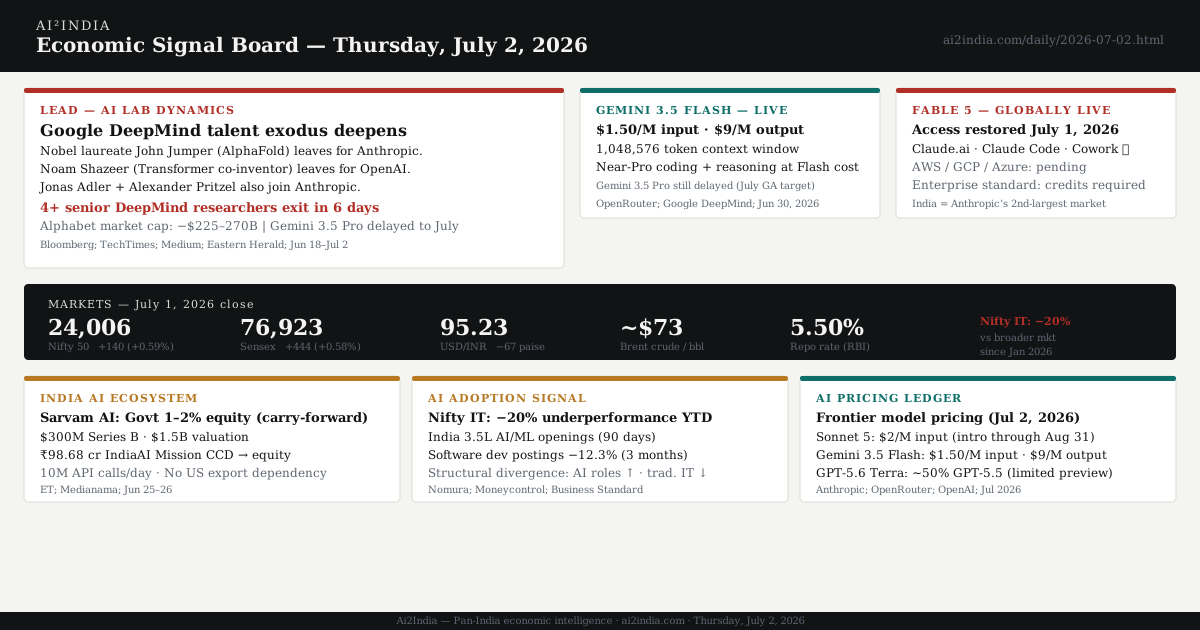
Google DeepMind’s talent crisis: Nobel laureate John Jumper, Transformer co-inventor Noam Shazeer, and two senior Gemini engineers leave for Anthropic and OpenAI in six days; Alphabet sheds $225–270 billion in market value; Gemini 3.5 Pro delayed from June to July as Gemini 3.5 Flash launches at $1.50 per million input tokens; Fable 5 confirmed live globally from July 1 — Claude.ai, Claude Code and Claude Cowork restored, with AWS/Google Cloud/Microsoft Foundry re-enabling “as quickly as possible.”
Thursday, July 2, 2026 opens with the most significant talent-driven competitive shift in the global AI landscape since the wave of OpenAI departures in 2023. In the span of six days in June 2026, Google DeepMind lost four of its most consequential researchers to its two principal rivals. The cascade began on June 18 when Noam Shazeer — a Google vice president and co-author of the original “Attention Is All You Need” transformer paper whose architecture underlies nearly every large language model in commercial use today — confirmed he was leaving for OpenAI. The next day, John Jumper — the Google DeepMind scientist whose AlphaFold protein-structure research contributed directly to the 2024 Nobel Prize in Chemistry — posted on X that he was leaving for Anthropic after nearly nine years at the company. Within the same week, senior Gemini engineers Jonas Adler and Alexander Pritzel also confirmed departures for Anthropic. The market’s response was immediate and severe: Alphabet lost between $225 billion and $270 billion in market capitalisation in the days surrounding the announcements. Simultaneously, Google confirmed it was pushing the general availability of Gemini 3.5 Pro — already delayed from its originally promised June launch — into July, citing quality refinements after early enterprise testing. As the Pro model waits, Google has deployed Gemini 3.5 Flash — a high-efficiency multimodal model priced at $1.50 per million input tokens and $9 per million output tokens with a 1,048,576-token context window — as the currently available frontier option for Indian enterprise teams needing an upgrade from Gemini 2.5 Flash. For Indian enterprise AI planners, the July 2 picture is materially different from just three weeks ago: Fable 5 is globally restored (with enterprise and cloud-provider nuances), Sonnet 5 offers near-Opus agentic capability at $2 per million input tokens, Gemini 3.5 Flash provides a sub-$2 frontier option, and the Google DeepMind talent exodus raises structural questions about the competitive trajectory of the Gemini model family that were not on the planning radar in June.
The Google DeepMind talent exodus is the most consequential AI competitive event of the week — and potentially of the quarter — for Indian enterprise teams using Google Cloud AI as their primary infrastructure. The departures are not a one-off: TechTimes (Jun 28) documented that six Google DeepMind researchers have left for Meta, OpenAI and Anthropic in 2026, with the rate of departures accelerating sharply in June. A 2025 SignalFire analysis — cited by the Los Angeles Times — found that DeepMind engineers are “nearly 11 times more likely to leave for Anthropic than the reverse.” The financial incentive is structural: both Anthropic and OpenAI are approaching initial public offerings, offering pre-IPO equity that a publicly traded Alphabet cannot match structurally. Noam Shazeer’s departure to OpenAI on June 18 was notable because Shazeer is one of the eight co-authors of “Attention Is All You Need” (Vaswani et al., 2017) — the transformer paper that is the intellectual foundation of GPT, Gemini, Claude and virtually every commercially significant language model in existence. John Jumper’s departure to Anthropic on June 19 carries a different kind of weight: Jumper’s AlphaFold work at DeepMind is the most scientifically validated AI-for-science project in history, and his move to Anthropic signals that Anthropic is building a serious AI-for-science capability that extends well beyond language modelling. Jonas Adler and Alexander Pritzel — also confirmed as leaving for Anthropic in Bloomberg’s June 24 report — were senior contributors to the Gemini model family. The cumulative talent loss matters for Indian enterprise teams in two ways: (1) The Gemini model family has lost several of its most experienced architects in a short window, precisely as Gemini 3.5 Pro is delayed and the model roadmap is uncertain. (2) Anthropic is simultaneously gaining the institutional knowledge of DeepMind’s most decorated researchers alongside the restored Fable 5 access and the new Sonnet 5 launch — compounding its momentum at an accelerating rate. For Indian enterprise teams that chose Google Cloud AI as their primary AI infrastructure: this is not a reason to immediately migrate, but it is a reason to formally review your model-provider diversification strategy in Q3 2026. The talent signal is a leading indicator of model capability trajectory.
Gemini 3.5 Flash is now available — and is the most relevant Google AI news for Indian enterprise teams today. While Gemini 3.5 Pro remains in limited preview (general availability targeted for July 2026; still unconfirmed as of July 2), Gemini 3.5 Flash has been deployed as the broadly available upgrade from the 2.5 Flash generation. Key specifications: $1.50 per million input tokens; $9 per million output tokens; 1,048,576-token context window; described by Google as a “high-efficiency multimodal model bringing near-Pro level coding and reasoning at Flash-tier cost and speed.” For Indian enterprise teams comparing frontier model options today: Gemini 3.5 Flash at $1.50/M input sits between Anthropic’s Sonnet 5 introductory rate ($2/M through August 31) and the general pricing landscape for near-frontier capability. The context window — at 1,048,576 tokens — is materially larger than Sonnet 5’s context and is directly relevant to Indian enterprises working with long-document processing (regulatory filings, contracts, financial reports) or multi-session agentic workflows. For Indian GCCs and IT services teams already committed to Google Cloud infrastructure: Gemini 3.5 Flash is the recommended upgrade path from Gemini 2.5 Flash pending Gemini 3.5 Pro’s GA. For teams evaluating whether to stay on Google Cloud AI vs. migrate to Anthropic or OpenAI infrastructure: today’s signals (Flash available, Pro delayed, talent exodus) are collectively negative for the “wait for Pro” strategy. Gemini 3.5 Flash is a capable model, but the Gemini 3.5 Pro delay means the flagship capability uplift that Google had promised for June has not materialised in July as of this writing.
Fable 5’s global restoration (July 1, 2026) is fully confirmed — with nuances that Indian enterprise teams must understand. Anthropic’s official blog post “Redeploying Claude Fable 5” (published June 30, 2026) confirms: “As of today, June 30, the export controls on Fable 5 and Mythos 5 have been lifted.” Access restoration on July 1 covers: Claude.ai (consumer and professional interface), Claude Code (developer IDE integration), and Claude Cowork (collaborative workspace). However, several important caveats apply for Indian enterprise teams: (1) AWS Bedrock, Google Cloud Vertex AI, and Microsoft Azure Foundry: Anthropic states it will “re-enable access on AWS, Google Cloud, and Microsoft Foundry as quickly as possible” — but as of July 2, restoration on these cloud platforms is still in progress, not confirmed complete. Indian enterprises whose production AI workloads run on these platforms should not assume Fable 5 is available to them today. (2) Enterprise plan caveats: for standard Enterprise seats, there is no included Fable 5 allowance — access requires usage credits. For premium Enterprise seats, Fable 5 is available up to 50% of weekly usage limits through July 7, after which it moves to usage credits. (3) The original biometric-ID / Persona verification pathway that Anthropic had announced for July 8 is now superseded by the full export control lift — no biometric verification will be required for restored Fable 5 access. For Indian developers and startups using direct Anthropic API access: Fable 5 and Mythos 5 are fully available today. For Indian enterprises running on AWS/GCP/Azure: verify platform-specific restoration status before restoring Fable 5 to production pipelines. Rediff.com (Jul 1) noted that “India is Anthropic’s second-largest” market — making the complete restoration of platform-level access a significant commercial priority for Anthropic.