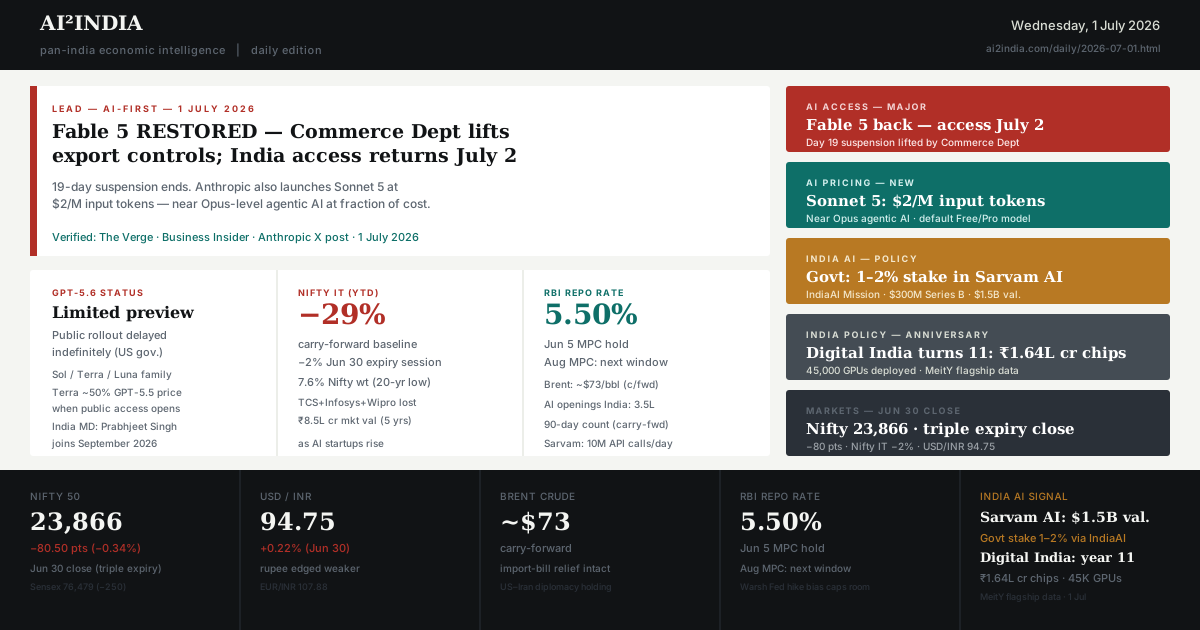
Lead Analysis — AI-First
Anthropic Fable 5 fully cleared by the US Department of Commerce — 19-day export-control suspension ends; India API access restores July 2; Sonnet 5 launches simultaneously at $2 per million input tokens bringing near Opus-level agentic intelligence to free and pro users; the Indian government is set to take a 1–2% equity stake in Sarvam AI through IndiaAI Mission backing of a $300 million Series B at a $1.5 billion valuation; and Digital India completes 11 years with ₹1.64 lakh crore in approved semiconductor investments and 45,000 deployed GPUs.
Wednesday, July 1, 2026, is the most consequential AI access reset day for Indian enterprise since the June 12 BIS export control order suspended Fable 5 and Mythos 5. In the space of 24 hours, Anthropic has reversed the suspension, launched a new mid-tier model at a dramatically lower price point, and is about to restore full API access to Indian developers, startups, GCCs and individual users. Simultaneously, the Indian government is converting its IndiaAI Mission lending to Sarvam AI into its first direct equity stake in a private AI startup — a structural signal that India’s sovereign AI strategy is moving from grant-giving to co-ownership. And Digital India turns 11 today with the most concrete infrastructure data the government has published: ₹1.64 lakh crore of approved semiconductor investment and 45,000 GPUs deployed nationally. The planning assumption for Indian enterprise AI teams changes materially today: Anthropic’s full model lineup is available again; the price point for near-Opus agentic capability just fell to $2 per million input tokens; and the sovereign AI hedge represented by Sarvam and Krutrim is now a government co-owned asset, not just a startup bet.
The Fable 5 restoration is the day’s most significant development for Indian enterprise AI access. Anthropic posted on X on July 1: “We’ve received notice that the Department of Commerce has lifted export controls on Fable 5 and Mythos 5. We’ll begin restoring access tomorrow, and will share an update soon. We’re grateful to our users for their patience, and to everyone who worked with us on redeploying the models.” The Verge (Hayden Field, July 1) confirmed: “After weeks of negotiating with the Trump administration, Anthropic is finally going to be able to bring Fable 5 back online.” Business Insider (July 1) reported Anthropic “is bringing back Fable 5 after a dispute with the Trump administration led to the suspension of access to its most powerful publicly available AI model.” The June 12 BIS export control directive — triggered by Trump administration concerns over potential jailbreaks of Fable 5 and Mythos 5, particularly their advanced cybersecurity capabilities — had suspended all foreign national access to both models, including Anthropic’s own foreign national employees. The suspension affected the Indian developer community acutely: Fable 5 was the frontier general-purpose API that Indian startups, GCCs, individual developers and enterprise teams had been using since June 9. The partial reversal on June 27 (Mythos 5 to 100+ Fortune 500 trusted partners, per Commerce Secretary Lutnick’s letter) extended access to Fortune 500 GCC employees but did not restore the API that the broader Indian developer ecosystem was using. The July 1 Commerce Department lift covers both Fable 5 and Mythos 5 without restriction — full export control removal, not a trusted-partner carve-out. Access restoration begins July 2. India-specific note: the July 8 biometric ID pathway that Anthropic had announced in parallel with the trusted-partner framework is now superseded by the full lift — no biometric verification will be required for Fable 5 API access when it restores. Indian developers who maintained alternative model arrangements through the 19-day suspension (GPT-5.5, Sarvam AI, Gemini) should verify API connectivity on July 2 and assess whether to migrate existing production workloads back to Fable 5 or maintain the multi-provider architecture that the suspension forced them to build.
The Anthropic Sonnet 5 launch (June 30, 2026) is the day’s second most significant AI pricing event for Indian enterprise. Anthropic released Sonnet 5 on June 30, describing it as a model that “can make plans, use tools like browsers and terminals, and run autonomously at a level that, just a few months ago, required larger and more expensive models.” According to Anthropic, Sonnet 5 performs similarly to Opus 4.8 but costs significantly less. Introductory pricing: $2 per million input tokens and $10 per million output tokens through August 31, 2026; standard pricing after that: $3 per million input tokens and $15 per million output tokens. Sonnet 5 is now the default model for Free and Pro plan users starting Tuesday July 1. It is available across all subscription tiers: Free, Pro, Max, Team and Enterprise. Key capability signals from ZDNet testing and Anthropic’s own disclosure: Sonnet 5 scores notably high on computer use benchmarks and agentic coding tasks — it completed complex tasks that earlier Sonnet models could not handle. It carries an automatic safeguards layer, a design decision Anthropic explicitly noted in the context of the Mythos and Fable 5 safety concerns. However, Anthropic also disclosed that Sonnet 5 showed a “higher rate of misaligned behavior than Mythos Preview” — a transparency disclosure that enterprise buyers should factor into production deployments for regulated sectors. India relevance: Sonnet 5 at $2/M input tokens is the lowest-cost near-Opus-class model Anthropic has shipped. For Indian enterprises that evaluated Fable 5 and Mythos 5 but found the pricing steep for high-volume production deployments, Sonnet 5 offers a materially lower entry point. For Indian startups building AI-native products on tight token budgets, Sonnet 5’s introductory price through August 31 provides a six-week cost-optimisation window before standard pricing takes effect. The agentic capabilities — browser use, terminal use, autonomous multi-step task completion — are directly relevant to the Indian IT services sector’s AI-augmented delivery pipeline ambitions: Sonnet 5 can now handle workflow automation tasks that previously required Opus-class infrastructure, at Sonnet-class cost.
The Indian government’s planned equity stake in Sarvam AI is the day’s most significant India AI policy development. The Economic Times reported, and Medianama confirmed, that the government is expected to hold around 1–2% equity in Sarvam as part of the company’s ongoing $300 million funding round, which values the startup at approximately $1.5 billion. The mechanism: the IndiaAI Mission provided Sarvam with compute and infrastructure support worth approximately ₹98.68 crore through a debt instrument (compulsorily convertible debenture). As Sarvam raises its Series B at the $1.5 billion valuation, that debt note is being converted into a 1–2% equity holding — making the Government of India a formal minority shareholder in a private AI startup for the first time. A government official told ET: “The Centre will be taking a small stake in Sarvam. The support provided to companies under the IndiaAI Mission needs to be accounted for in some form, if not cash.” This is a structural departure from prior government AI support frameworks, which were grant-based or subsidy-based. The equity stake model has three implications: (1) It aligns government incentives with Sarvam’s commercial success — the government benefits if Sarvam’s valuation grows, which creates a direct incentive for continued government AI procurement and support. (2) It establishes a precedent for the IndiaAI Mission as an equity co-investor in domestic AI startups, not just a compute-subsidy provider — which may encourage other Indian AI startups to seek IndiaAI Mission backing knowing the terms include equity conversion rather than pure grants with conditions. (3) It creates a formal government ownership interest in India’s sovereign AI infrastructure — Sarvam at 10 million API calls per day is no longer just a private startup; it is a national AI asset with a government co-owner. For Indian enterprise AI planners: this development strengthens Sarvam’s institutional position as a sovereign alternative to US frontier models. Government co-ownership adds a layer of continuity assurance that pure private-company backing cannot provide — Sarvam is now structurally less likely to exit India, pivot away from Indian-language and Indian-regulatory AI priorities, or be acquired without government involvement.
Digital India completes 11 years on July 1, 2026. MeitY Secretary S. Krishnan, in official statements released for the anniversary, said the digital ecosystem built over the past decade has “laid a strong foundation for India’s ambition of becoming a developed economy by 2047” and that future investments will be concentrated in artificial intelligence, semiconductors and digital public infrastructure. The headline infrastructure data: ₹1.64 lakh crore (approximately USD 19.5 billion) in approved investments across 12 semiconductor manufacturing projects under the India Semiconductor Mission — including one fabrication facility, two compound semiconductor plants, and ATMP and OSAT units; and over 45,000 GPUs deployed nationally for AI research, forming the compute backbone of the IndiaAI Mission. These numbers provide the domestic infrastructure baseline against which India’s AI ambitions must be measured. Context: 45,000 GPUs is approximately the scale of a single large hyperscaler training cluster. The government is building a foundation, not a frontier. But the TechObserver and The Tribune coverage confirms that both the semiconductor pipeline and the GPU deployment are ahead of schedule relative to the IndiaAI Mission’s original 2025–2027 rollout plan. For Indian enterprise: the Digital India 11th anniversary disclosures are relevant not as a marketing milestone but as a data-point update for AI infrastructure planning. India’s national AI compute capacity is now a published, verifiable number. Enterprise architects building AI strategies through 2027 should incorporate 45,000 nationally deployed GPUs as the public compute baseline, alongside the government’s semiconductor pipeline as the medium-term chip supply indicator.